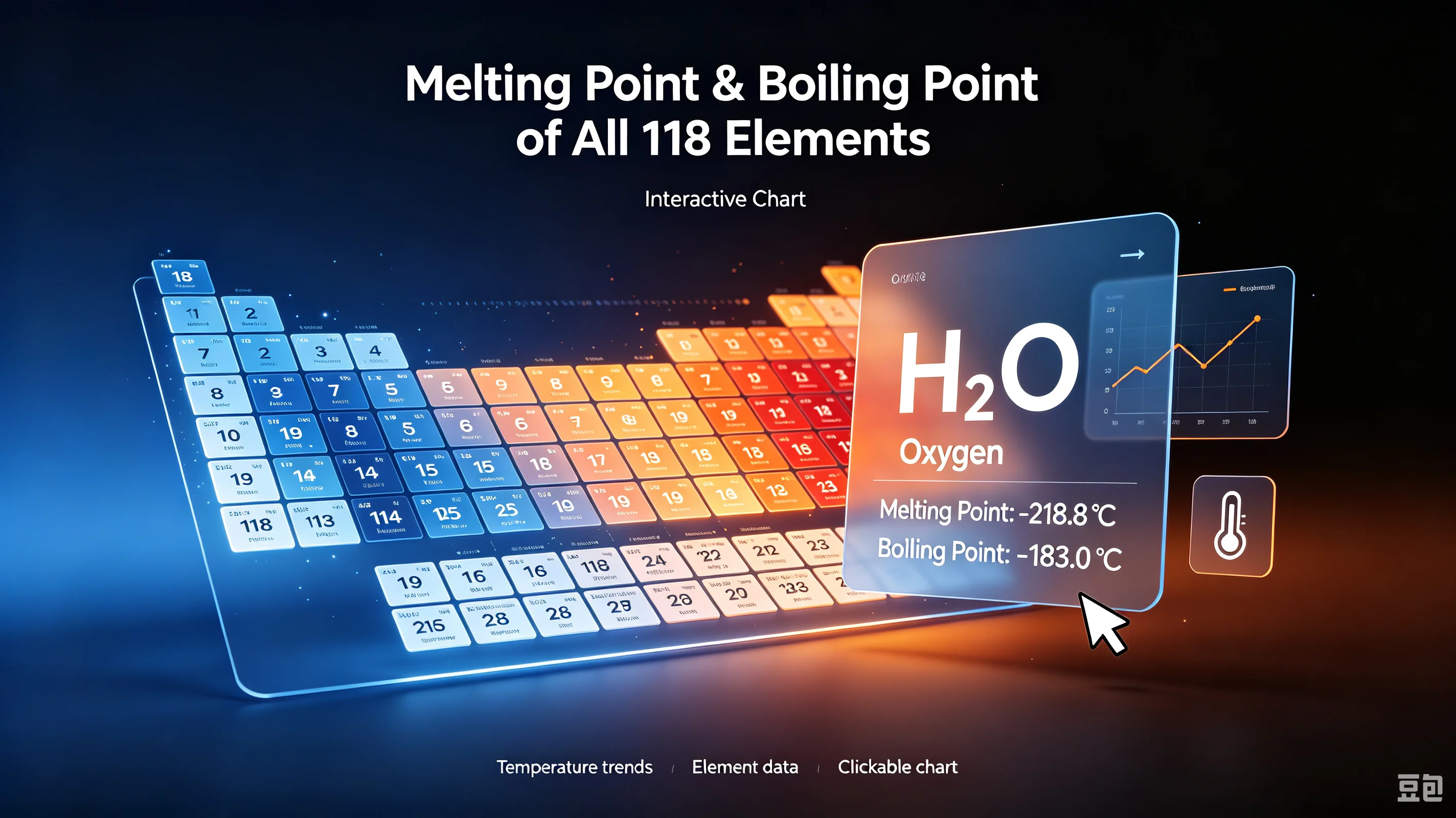
Melting and boiling points for all 118 elements. Use the interactive temperature slider to see which elements are solid, liquid, or gas at any temperature. Data sourced from standard references.
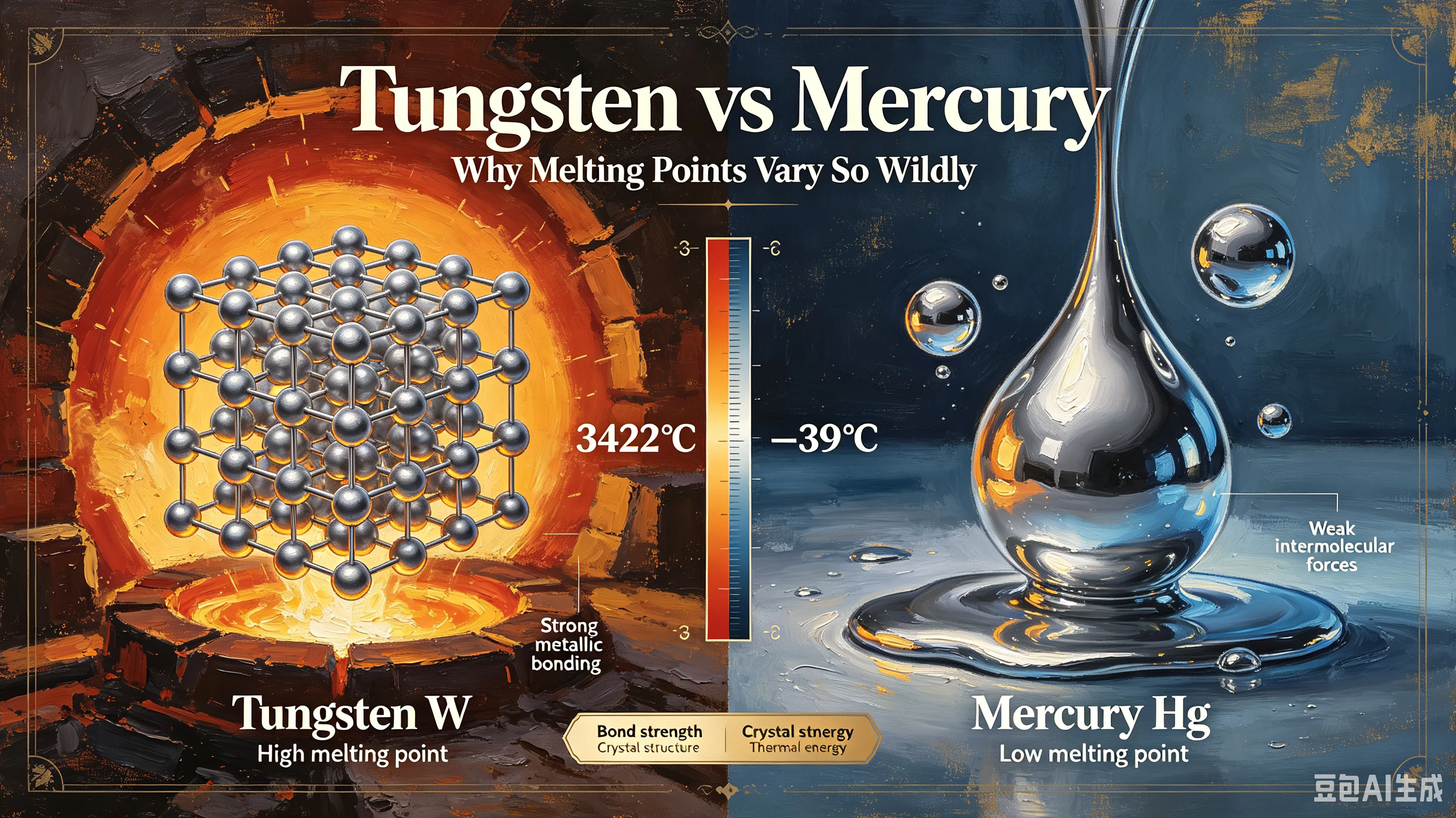
Every element melts and boils — but at wildly different temperatures. Tungsten stays solid until 3,422°C, while helium never freezes at standard pressure at all. Understanding these phase changes is essential for everything from metallurgy to cryogenics. This guide covers the key melting and boiling point trends, the record-holding elements, and how to explore all 118 elements interactively with a temperature slider.
The Record Holders
Before diving into trends, here are the elements at the extremes:
Record | Element | Value |
|---|---|---|
Highest melting point | Tungsten (W) | 3,422°C |
Lowest melting point | Helium (He) | -272.2°C (at 25 atm; no solid at 1 atm) |
Highest boiling point | Rhenium (Re) | 5,596°C |
Lowest boiling point | Helium (He) | -268.9°C |
Liquid at room temperature (25°C) | Mercury (Hg), Bromine (Br) | Hg: -38.8°C, Br: -7.2°C |
Melts just above room temp | Cesium (Cs), Gallium (Ga), Rubidium (Rb), Francium (Fr) | 27–39°C |
Tungsten's extreme melting point is why it's used in light bulb filaments and rocket nozzles. Helium, at the other end, remains liquid down to absolute zero at standard pressure — it only solidifies under 25 atmospheres of pressure.
Melting Point Trends Across the Periodic Table
Melting points don't follow a simple left-to-right or top-to-bottom pattern. Instead, they depend on bond type and bond strength:
Metals generally have high melting points because metallic bonds are strong. Within the transition metals, melting points peak around Groups 5–7 (tungsten, rhenium, molybdenum) where d-orbital bonding is maximized.
Nonmetals have low melting points because they're held together by weak intermolecular forces (van der Waals). Noble gases have the lowest of all.
Covalent network solids (carbon, boron, silicon) have extremely high melting points because every atom is bonded to neighbors in a continuous lattice — melting requires breaking strong covalent bonds.
The result is a periodic table where the center (transition metals) is hot, the upper right (nonmetals) is cold, and carbon (diamond) and tungsten are the outliers at the very top.
Boiling Point Trends
Boiling points roughly correlate with melting points, but the relationship isn't perfect. Key observations:
Rhenium and tungsten have the highest boiling points (over 5,500°C), reflecting their exceptionally strong metallic bonding.
Helium has the lowest boiling point (-268.9°C) — so low that it's used as a cryogen for MRI machines and quantum computing.
The noble gases show a clear trend: boiling point increases as you go down the group (He: -269°C → Ne: -246°C → Ar: -186°C → Kr: -153°C → Xe: -108°C → Rn: -62°C) because larger atoms have stronger van der Waals forces.
The halogens follow the same pattern: F₂ boils at -188°C, Cl₂ at -34°C, Br₂ at 59°C, I₂ at 184°C.
Explore Interactively With a Temperature Slider
A static table of 118 melting and boiling points is hard to absorb. An interactive periodic table with a temperature slider makes it intuitive: drag the slider to any temperature, and every element tile changes color based on whether it's solid, liquid, or gas at that temperature.
Here's how to use it:
Step 1: Set a temperature. Drag the slider or type a value. Start at 25°C (room temperature) to see the baseline.
Step 2: Observe the phases. At 25°C, almost every element is solid — except mercury and bromine (liquid) and the noble gases, nitrogen, oxygen, fluorine, and chlorine (gas).
Step 3: Raise the temperature. Drag toward 100°C. Cesium (28.4°C) and gallium (29.8°C) melt almost immediately. By 100°C, rubidium (39.3°C), francium (~27°C), and several more have joined the liquid phase.
Step 4: Keep going. At 500°C, most alkali and alkaline earth metals are liquid. At 1,000°C, many transition metals melt. At 3,500°C, even tungsten finally gives up — and only carbon (sublimes at ~3,600°C) and a handful of refractory metals remain solid.
Step 5: Go low. Drag toward -200°C. Most gases condense into liquids, then freeze. At -269°C, even helium boils — and below that, only helium remains liquid (at standard pressure).
This interactive approach turns 236 data points (118 melting + 118 boiling) into a visual story you can explore in seconds.
Why These Numbers Matter
Materials science — choosing metals for high-temperature applications (turbine blades, furnace parts) depends on melting points.
Cryogenics — liquid nitrogen (-196°C) and liquid helium (-269°C) are essential for superconductors and medical imaging.
Chemistry lab work — knowing boiling points lets you set distillation temperatures and predict which compounds are volatile.
Education — phase trends reinforce bonding concepts: strong bonds = high melting point, weak intermolecular forces = low melting point.
Common Questions
Which elements are liquid at room temperature? Only two: mercury (Hg, melts at -38.8°C) and bromine (Br, melts at -7.2°C). Four more — cesium, gallium, rubidium, and francium — melt between 27°C and 40°C, so they're liquid on a warm day or in your hand.
Why does gallium melt in your hand? Gallium melts at 29.8°C — below human body temperature (37°C). It's one of the few elements you can literally melt by holding it.
Is there an element with no melting point? At standard atmospheric pressure, helium never solidifies — it remains liquid all the way to absolute zero. You need at least 25 atm of pressure to freeze helium.
What's the difference between melting point and freezing point? For pure substances, they're the same temperature — melting point (solid → liquid) and freezing point (liquid → solid) describe the same phase boundary from opposite directions.
Start Exploring
Open the chembioTube Interactive Periodic Table with the temperature slider and property heatmap. Drag to any temperature, watch elements change phase in real time, and click any tile for full melting and boiling point data. Free, no signup, runs in your browser.