Tungsten melts at 3,422°C while mercury melts at -39°C — a 3,461°C gap between two metals in the same period. Learn how electron configuration, d-orbital bonding, and relativistic effects explain the wildest melting point contrast in the periodic table. Interactive melting point heatmap included.
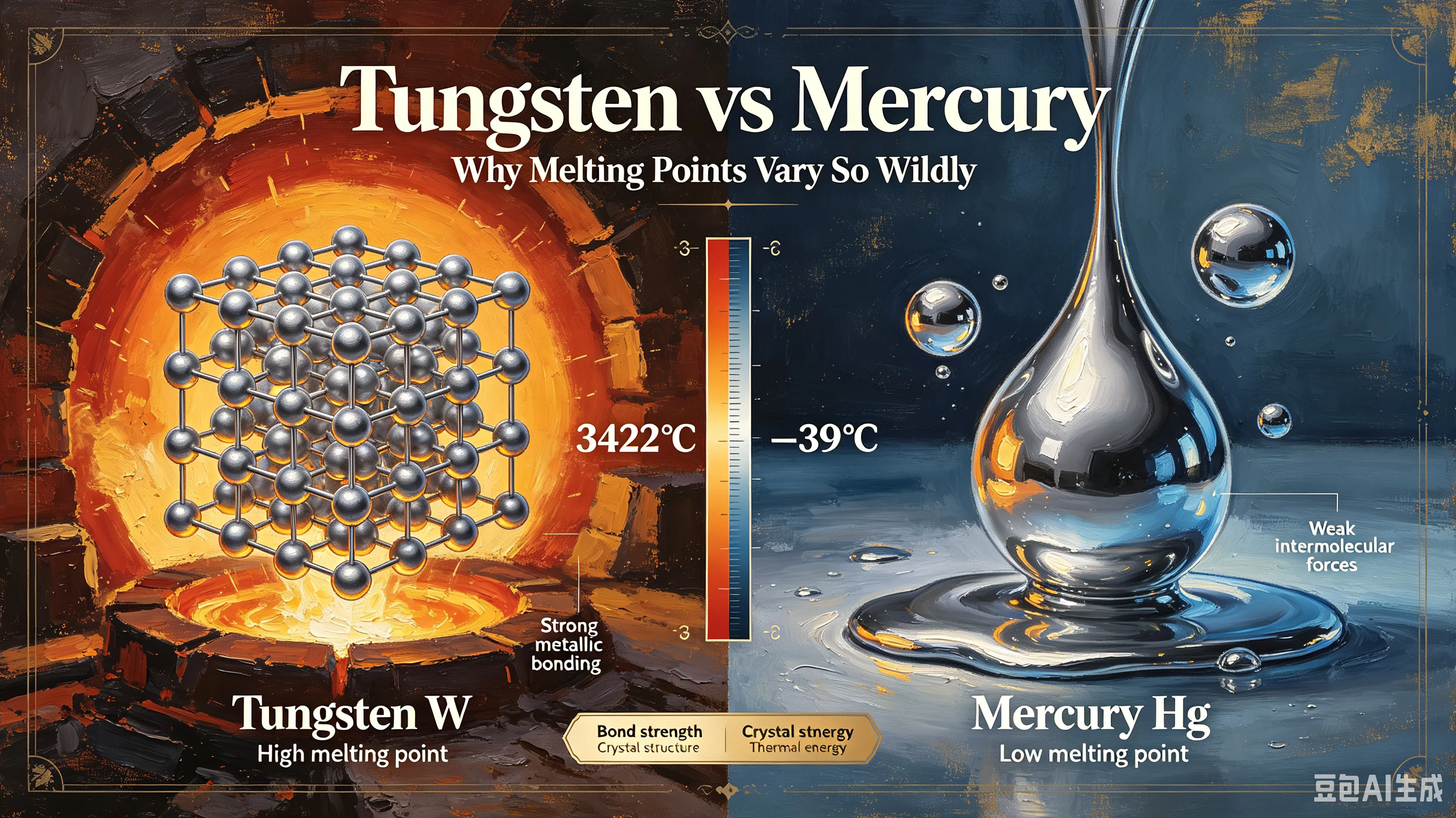
Tungsten and mercury are both metals. Both sit in Period 6 of the periodic table. Both are dense, silvery, and conduct electricity. Yet tungsten stays solid until 3,422°C — hot enough to survive a rocket nozzle — while mercury is a liquid at room temperature, melting at -38.83°C. The gap is 3,461 degrees, wider than the entire temperature range from absolute zero to the melting point of iron. How can two elements so close on the periodic table behave so differently? The answer lies in their electrons — specifically, how many unpaired d-electrons they have and whether relativistic effects lock their valence electrons away. This guide breaks down the physics behind the most extreme melting point contrast in chemistry.
The Numbers Side by Side
Property | Tungsten (W) | Mercury (Hg) |
|---|---|---|
Atomic number | 74 | 80 |
Electron config | [Xe] 4f¹⁴ 5d⁴ 6s² | [Xe] 4f¹⁴ 5d¹⁰ 6s² |
Melting point | 3,422°C | -38.83°C |
Boiling point | 5,555°C | 356.7°C |
Crystal structure (solid) | Body-centered cubic | Rhombohedral (distorted) |
Density | 19.3 g/cm³ | 13.5 g/cm³ |
Unpaired d-electrons | 4 | 0 |
Key use | Light bulb filaments, rocket nozzles | Thermometers (historical), fluorescent lamps |
Both elements have the same xenon core and the same 4f¹⁴ lanthanide shell. They differ by just six protons and six electrons: tungsten has 5d⁴, mercury has 5d¹⁰. That six-electron difference is the entire story.
What Determines a Metal's Melting Point?
A metal melts when thermal energy overcomes the metallic bonds holding its atoms in a lattice. The stronger the bonding, the higher the melting point. Metallic bonding strength depends on:
Number of unpaired valence electrons — more unpaired electrons = more electrons delocalized into the "sea" of metallic bonding = stronger bonds.
Orbital overlap — d-orbitals overlap more effectively than s-orbitals in transition metals, creating stronger directional bonding.
Nuclear charge vs. atomic radius — higher Zeff pulls atoms closer, increasing bond strength.
Electron configuration stability — filled or half-filled subshells are less available for bonding.
Tungsten maximizes factors 1 and 2. Mercury minimizes them — and adds a relativistic twist that makes its valence electrons nearly unavailable.
Why Tungsten Has the Highest Melting Point of Any Metal
Tungsten's electron configuration is [Xe] 4f¹⁴ 5d⁴ 6s². Its 5d subshell has four unpaired electrons — each one contributes to metallic bonding. In a body-centered cubic (BCC) lattice, each tungsten atom has 8 nearest neighbors, and the delocalized 5d electrons form strong, directional bonds between them.
The result is one of the strongest metallic bonding networks in the periodic table:
High bond energy — tungsten's cohesive energy (energy to separate the solid into isolated atoms) is ~8.9 eV/atom, among the highest of any element.
Short interatomic distance — tungsten atoms are packed tightly (atomic radius ~139 pm), increasing orbital overlap.
BCC structure stability — the BCC lattice, combined with strong d-bonding, resists shear and thermal disruption.
Tungsten isn't alone at the top. The melting point peak across transition metals sits in Groups 5–7: tantalum (3,017°C), molybdenum (2,623°C), rhenium (3,186°C), and osmium (3,033°C) are all above 3,000°C. These elements all have partially filled d-subshells with 3–6 unpaired electrons. As you move past Group 7, d-electrons start pairing up, bonding weakens, and melting points drop. By Group 12 (zinc, cadmium, mercury), the d-subshell is completely full — and melting points collapse.
Why Mercury Is Liquid at Room Temperature
Mercury's configuration is [Xe] 4f¹⁴ 5d¹⁰ 6s². Every subshell is full: 5d¹⁰ (all paired), 6s² (all paired). There are zero unpaired electrons available for metallic bonding. That alone would give mercury a low melting point — but it gets worse (or weirder) due to relativistic effects.
The relativistic 6s contraction:
In heavy elements like mercury (Z = 80), inner-shell electrons move at a significant fraction of the speed of light. By special relativity, their mass increases, and by the laws of quantum mechanics, their orbital radius shrinks. This contraction is most pronounced for s-orbitals (which have electron density near the nucleus) and cascades outward: the 6s orbital in mercury contracts significantly, pulling the 6s electrons closer to the nucleus and making them much less available for bonding.
The combined effect — full d-subshell + relativistically contracted 6s² — means mercury's valence electrons barely participate in metallic bonding at all. Mercury atoms behave almost like noble gas atoms: weakly interacting, easily separated, liquid at low temperature. Some chemists describe mercury as "a pseudo-noble gas that happens to be a liquid metal."
Evidence for this weak bonding:
Low cohesive energy — mercury's cohesive energy is only ~0.67 eV/atom, ~13× weaker than tungsten's.
Low boiling point — mercury boils at 356.7°C, far below any other transition metal.
Monatomic gas — mercury vapor is almost entirely monatomic (Hg atoms, not Hg₂ molecules), unlike most metal vapors.
Poor conductor — mercury is a mediocre electrical conductor for a metal (resistivity ~9.8×10⁻⁷ Ω·m), because its electrons aren't fully delocalized.
Mercury isn't the only low-melting metal. Gallium (29.8°C), cesium (28.4°C), and francium (~27°C) also melt near room temperature. But mercury is unique in being a liquid at standard room temperature while being a heavy transition metal — and the relativistic 6s contraction is the reason.
The Same Period, Opposite Extremes
Tungsten and mercury are only six positions apart in Period 6. Walking from tungsten to mercury across the periodic table, the d-subshell fills up:
Element | Group | d-electrons | Unpaired d-e⁻ | Melting point |
|---|---|---|---|---|
Tungsten (W) | 6 | 5d⁴ | 4 | 3,422°C |
Rhenium (Re) | 7 | 5d⁵ | 5 | 3,186°C |
Osmium (Os) | 8 | 5d⁶ | 4 | 3,033°C |
Iridium (Ir) | 9 | 5d⁷ | 3 | 2,446°C |
Platinum (Pt) | 10 | 5d⁹ | 1 | 1,768°C |
Gold (Au) | 11 | 5d¹⁰ 6s¹ | 0 (in d) | 1,064°C |
Mercury (Hg) | 12 | 5d¹⁰ 6s² | 0 | -38.83°C |
The trend is clear: as d-electrons pair up, melting points plummet. Rhenium (5d⁵, half-filled d-subshell, 5 unpaired electrons) is the peak of the 5d series. By gold (5d¹⁰), the d-shell is full and melting has dropped 2,100°C from rhenium. Mercury adds the relativistic 6s contraction, pushing it all the way to negative temperatures.
This pattern repeats in every transition series: melting points peak at Groups 5–7 and bottom out at Group 12. The 6th period is just the most dramatic because relativistic effects amplify the Group 12 collapse.
Real-World Consequences
The extreme melting points of tungsten and mercury aren't just trivia — they define how humans use these elements:
Tungsten — the metal of extreme heat:
Incandescent light bulb filaments — tungsten is the only metal that can survive the 2,500–3,000°C operating temperature of a glowing filament without melting.
Rocket nozzles and re-entry vehicles — tungsten-lined nozzles survive the 3,000°C+ exhaust of rocket engines.
Cutting tools and armor — tungsten carbide (WC) is one of the hardest known materials, used in drill bits, machining tools, and armor-piercing rounds.
X-ray tubes and radiation shielding — tungsten's high density and melting point make it an excellent radiation shield.
Mercury — the liquid metal:
Thermometers and barometers — mercury's liquid state at room temperature and uniform thermal expansion made it the standard for temperature and pressure measurement for centuries (now phased out due to toxicity).
Fluorescent lamps — mercury vapor emits UV light when electrified, converted to visible light by phosphors.
Chlor-alkali process — mercury cathode cells were historically used to produce chlorine and sodium hydroxide (now largely replaced).
Dental amalgams — mercury mixed with silver, tin, and copper forms a workable paste that hardens into a durable filling (declining use due to toxicity concerns).
The contrast is stark: tungsten is used where things must not melt; mercury is used precisely because it's already liquid.
Common Questions
Is tungsten really the highest melting point element?
Tungsten has the highest melting point of any metal (3,422°C). Carbon has a higher sublimation point (~3,600°C at 1 atm) but doesn't melt at standard pressure — it sublimes. Under high pressure, carbon melts at ~4,600°C. So tungsten is the highest melting metal; carbon is the most heat-resistant element overall.
Why is mercury toxic if it's "like a noble gas"?
Mercury's toxicity comes from its chemical behavior in the body, not its bonding in pure form. Elemental mercury vapor is absorbed by lungs, crosses the blood-brain barrier, and is converted to methylmercury by bacteria — an organomercury compound that binds sulfur in proteins and disrupts neural function. The "noble gas-like" description applies to pure mercury's weak interatomic bonding, not to mercury compounds.
Can you alloy tungsten and mercury?
Not practically. Tungsten is essentially insoluble in mercury at room temperature, and the temperature needed to dissolve tungsten (above 3,422°C) is far above mercury's boiling point (357°C). Mercury amalgams form with metals like silver, gold, copper, and tin — not with refractory metals like tungsten.
Do all heavy elements have relativistic effects?
Yes, but they become significant only above ~Z = 60. Gold's yellow color (instead of silvery like other metals) and cesium's slight golden tint are also relativistic effects. Mercury's liquid state is the most dramatic example. Element 112 (copernicium) is predicted to be even more mercury-like — possibly a gas at room temperature — due to even stronger relativistic 7s contraction.
Why does rhenium have a higher boiling point than tungsten but lower melting point?
Rhenium (5d⁵) has 5 unpaired d-electrons vs. tungsten's 4, giving it slightly stronger overall bonding in the liquid state (higher boiling point, 5,596°C). But tungsten's BCC crystal structure is more stable against melting than rhenium's HCP structure, so tungsten has the higher melting point. The two properties don't always track perfectly because crystal structure matters for melting but not for boiling.
Is there a metal with a melting point between tungsten and mercury?
Every other metal. The 3,461°C gap between tungsten and mercury spans the entire range of metallic melting points. From tungsten down, you pass rhenium, osmium, tantalum, molybdenum, iron, copper, gold, silver, aluminum, magnesium, zinc, and finally mercury — a smooth (if steep) decline as d-electrons pair up and s-electrons become less available.
Visualize the Full Trend
A melting point heatmap makes the tungsten-to-mercury decline visible across the entire periodic table. The transition metal center glows warm red (high melting points), peaking at tungsten and rhenium, then fades to cool blue toward Group 12 (zinc, cadmium, mercury). Drag the temperature slider to watch mercury melt at -39°C while tungsten stays solid until 3,422°C — the most dramatic phase transition contrast in chemistry.
Open the chembioTube Interactive Periodic Table and switch to the melting point heatmap. Click tungsten (3,422°C) and mercury (-38.83°C) to compare, then drag the temperature slider from -273°C to 6,000°C to see every element change phase. Free, no signup, runs in your browser.