Predict ionic, polar covalent, or nonpolar covalent bonds from electronegativity difference (ΔEN). Learn the ΔEN thresholds, step-by-step method, worked examples for HCl, NaCl, HF and more, plus boundary cases like Fajans' rules. Free electronegativity lookup included.
Is the bond in NaCl ionic or covalent? What about HCl? Or the C–H bond in methane? These questions come up in every chemistry course, and the answer hinges on one number: the electronegativity difference (ΔEN) between the two bonded atoms. By looking up each atom's electronegativity and subtracting, you can classify any bond as nonpolar covalent, polar covalent, or ionic — no lab work required. This guide covers the thresholds, the step-by-step method, worked examples, and the boundary cases where the simple rules break down.
The Three Bond Types
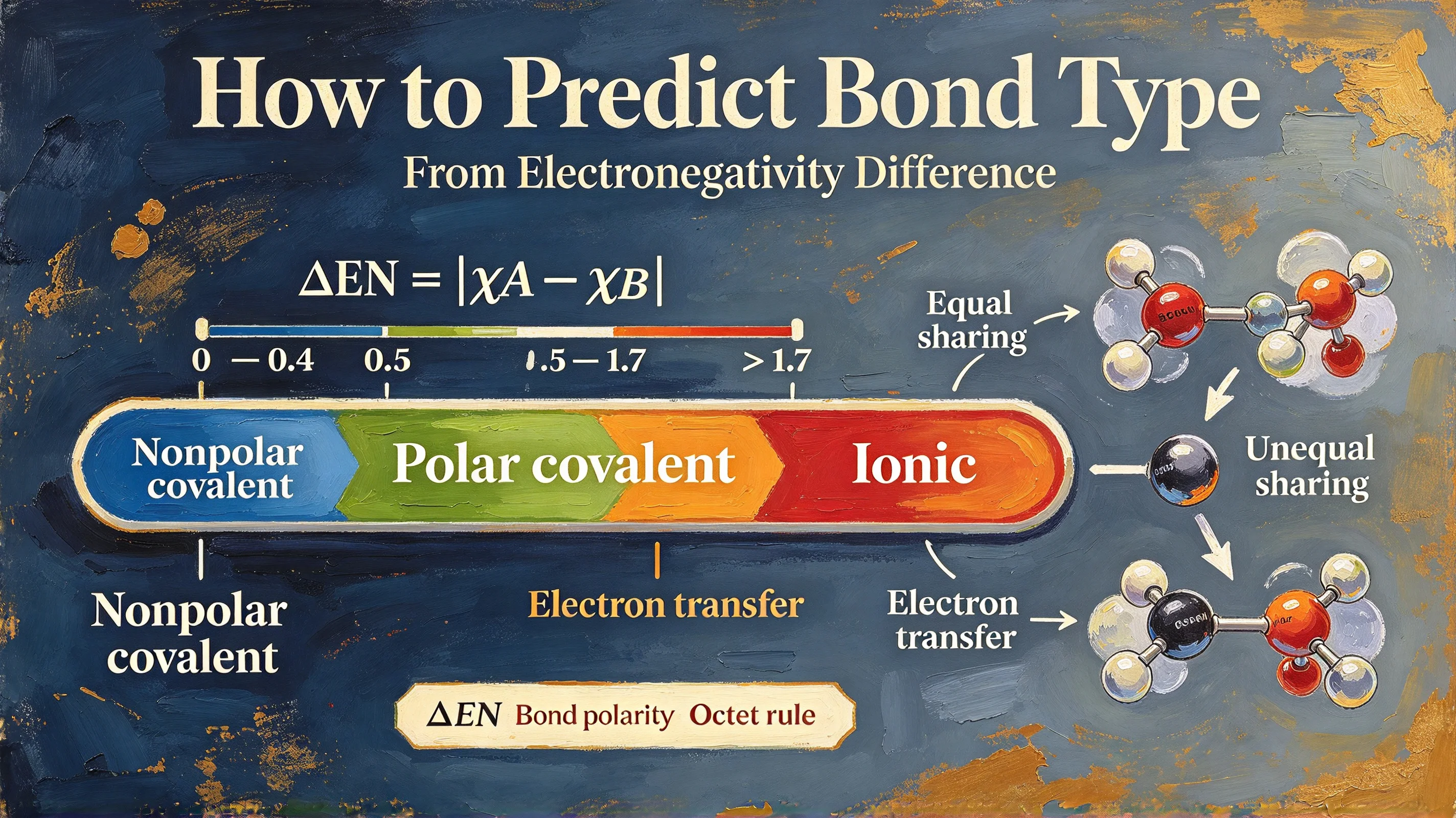
Chemical bonds fall into three broad categories based on how electrons are shared (or not shared):
1. Nonpolar covalent bond — electrons are shared equally (or nearly equally) between two atoms. No significant charge separation. Examples: H₂, O₂, N₂, C–H.
2. Polar covalent bond — electrons are shared unequally. The more electronegative atom pulls electron density toward itself, creating partial charges (δ+ and δ−). Examples: H₂O, HCl, NH₃, C–O.
3. Ionic bond — electrons are essentially transferred from one atom to another, creating full positive and negative ions (cation and anion) held together by electrostatic attraction. Examples: NaCl, KF, MgO, CaCl₂.
In reality, these are points on a continuum, not discrete boxes. A bond with ΔEN = 1.6 is "mostly covalent with significant ionic character"; one with ΔEN = 1.8 is "mostly ionic with some covalent character." The thresholds are convenient dividing lines, not phase transitions.
The ΔEN Thresholds
Calculate the electronegativity difference as:
ΔEN = |EN₁ − EN₂|
Always use the absolute value — bond polarity doesn't care which atom is listed first.
Then classify using these standard ranges:
ΔEN Range | Bond Type | Electron Behavior | Example |
|---|---|---|---|
0.0 – 0.4 | Nonpolar covalent | Equal sharing | H–H (0.0), C–H (0.35) |
0.5 – 1.7 | Polar covalent | Unequal sharing | H–Cl (0.96), O–H (1.24) |
> 1.7 | Ionic | Electron transfer | Na–Cl (2.23), K–F (3.16) |
Note on the 1.7 vs. 2.0 cutoff: Some textbooks use 2.0 instead of 1.7 as the ionic threshold. The difference matters only for bonds in the 1.7–2.0 gray zone (like H–F at 1.78). For general chemistry, 1.7 is the most widely used convention. When in doubt, describe a bond in this range as "polar covalent with significant ionic character" rather than picking one label.
Step-by-Step Method
Step 1: Identify the two bonded atoms. Write down the symbols of both atoms in the bond.
Step 2: Look up each atom's electronegativity. Use the Pauling scale (most common). Values are on any periodic table or electronegativity chart.
Step 3: Calculate ΔEN. Subtract the smaller value from the larger (or take absolute value of the difference).
Step 4: Compare to the thresholds.
ΔEN < 0.5 → nonpolar covalent
0.5 ≤ ΔEN ≤ 1.7 → polar covalent
ΔEN > 1.7 → ionic
Step 5: Determine the direction of polarity (for polar bonds). The atom with higher electronegativity is δ− (partially negative); the lower one is δ+ (partially positive). Draw an arrow from δ+ to δ− if needed.
Step 6: Check for exceptions (see below). If the bond involves a small, highly charged cation or a metal-metal pair, the simple rule may need adjustment.
Worked Examples
Example 1: HCl (hydrogen chloride)
H = 2.20, Cl = 3.16
ΔEN = |3.16 − 2.20| = 0.96
0.96 falls in 0.5–1.7 → polar covalent bond
Cl is more electronegative → Cl is δ−, H is δ+
This is why HCl dissolves in water to form H⁺ and Cl⁻ — the polar bond ionizes in solution.
Example 2: NaCl (sodium chloride)
Na = 0.93, Cl = 3.16
ΔEN = |3.16 − 0.93| = 2.23
2.23 > 1.7 → ionic bond
Na essentially transfers its 3s electron to Cl, forming Na⁺ and Cl⁻
NaCl is a crystalline salt with a high melting point (801°C) — classic ionic compound behavior.
Example 3: HF (hydrogen fluoride)
H = 2.20, F = 3.98
ΔEN = |3.98 − 2.20| = 1.78
1.78 is just above 1.7 → at the ionic/polar covalent boundary
In practice, HF is best described as a very polar covalent molecule. It's a gas at room temperature (not a salt), and the H–F bond has covalent character. But it's so polar that HF forms strong hydrogen bonds and is a weak acid in water. This is the gray zone — the ΔEN rule says "ionic," but the actual chemistry is "extremely polar covalent."
Example 4: CH₄ (methane, C–H bond)
C = 2.55, H = 2.20
ΔEN = |2.55 − 2.20| = 0.35
0.35 < 0.5 → nonpolar covalent bond
Methane is a nonpolar molecule overall (symmetric tetrahedral geometry cancels any bond dipoles).
Example 5: H₂O (water, O–H bond)
O = 3.44, H = 2.20
ΔEN = |3.44 − 2.20| = 1.24
1.24 falls in 0.5–1.7 → polar covalent bond
O is δ−, each H is δ+. The bent geometry makes water a polar molecule — the basis for hydrogen bonding, high boiling point, and solvent properties.
Example 6: KF (potassium fluoride)
K = 0.82, F = 3.98
ΔEN = |3.98 − 0.82| = 3.16
3.16 > 1.7 → ionic bond (one of the most ionic bonds known)
KF is a white crystalline salt, melting point 858°C, highly soluble in water.
Example 7: O₂ (oxygen gas)
O = 3.44, O = 3.44
ΔEN = 0.00
0.0 < 0.5 → nonpolar covalent bond (in fact, a double bond)
Any bond between identical atoms (H₂, N₂, Cl₂, O₂) is always nonpolar by definition.
Boundary Cases and Exceptions
The ΔEN rule works for ~90% of bonds you'll encounter in general chemistry. But there are important cases where it's misleading:
1. The 1.7–2.0 gray zone. Bonds like H–F (1.78), Ag–Cl (1.23 but with covalent character), and some metal oxides sit near the boundary. These bonds have mixed ionic-covalent character. The safest description is "polar covalent with significant ionic character" or "ionic with covalent character" depending on the chemistry.
2. Fajans' rules — when "ionic" bonds are actually covalent. Even if ΔEN > 1.7, a bond can have significant covalent character if:
The cation is small (high charge density, e.g., Al³⁺, Li⁺, Be²⁺)
The cation has high charge (+2, +3, +4)
The anion is large (easily polarized, e.g., I⁻, S²⁻)
Example: AlCl₃ has ΔEN = 1.55 (polar covalent by the rule), but even AlF₃ (ΔEN = 2.37, "ionic" by the rule) has notable covalent character because Al³⁺ is tiny and highly charged. AlCl₃ sublimes at 178°C (covalent behavior), while NaCl (ΔEN = 2.23) melts at 801°C (ionic behavior). Fajans' rules explain why: small, highly charged cations polarize the anion, pulling electron density back into a covalent sharing arrangement.
3. Metal–metal bonds. The ΔEN rule is for bonds between a metal and nonmetal (or two nonmetals). Bonds between two metals are metallic bonds — a delocalized "sea" of electrons — regardless of ΔEN. Even if two metals have a large ΔEN (e.g., Na–Au, ΔEN = 1.61), the bonding is metallic or intermetallic, not ionic or covalent in the usual sense.
4. Polyatomic ions. A compound like NaOH contains both an ionic bond (Na⁺–OH⁻, ΔEN = 2.60) and a covalent bond (O–H within OH⁻, ΔEN = 1.24). Always analyze each bond individually, not the whole compound.
5. Coordinate covalent bonds. When one atom donates both electrons to a bond (e.g., NH₃ + H⁺ → NH₄⁺, or metal-ligand complexes), the bond is covalent regardless of ΔEN. Once formed, it's indistinguishable from a normal covalent bond.
Quick Reference: Common Bonds
Bond | EN Values | ΔEN | Type |
|---|---|---|---|
H–H | 2.20, 2.20 | 0.0 | Nonpolar covalent |
C–H | 2.55, 2.20 | 0.35 | Nonpolar covalent |
C–C | 2.55, 2.55 | 0.0 | Nonpolar covalent |
N–H | 3.04, 2.20 | 0.84 | Polar covalent |
C–O | 2.55, 3.44 | 0.89 | Polar covalent |
H–Cl | 2.20, 3.16 | 0.96 | Polar covalent |
O–H | 3.44, 2.20 | 1.24 | Polar covalent |
H–F | 2.20, 3.98 | 1.78 | Very polar covalent (gray zone) |
Mg–O | 1.31, 3.44 | 2.13 | Ionic |
Na–Cl | 0.93, 3.16 | 2.23 | Ionic |
Li–F | 0.98, 3.98 | 3.00 | Ionic |
K–F | 0.82, 3.98 | 3.16 | Ionic (most ionic) |
Why This Matters
Predicting bond type isn't just an academic exercise — it tells you how a compound will behave:
Ionic compounds → high melting points, soluble in water, conduct electricity when molten or dissolved, form crystalline lattices.
Polar covalent compounds → lower melting points, may or may not dissolve in water, don't conduct electricity, often have dipole moments.
Nonpolar covalent compounds → lowest melting points (often gases at room temperature), insoluble in water, no dipole moment.
If you can predict the bond type from the formula, you can predict solubility, melting point, conductivity, and reactivity without doing a single experiment.
Common Questions
Is 1.7 or 2.0 the correct ionic cutoff? Both are used. The 1.7 cutoff comes from Linus Pauling's original work and is standard in most general chemistry textbooks. The 2.0 cutoff is used in some advanced texts. For bonds between 1.7 and 2.0, describe the bond as having mixed character rather than forcing a label.
Can a bond be 100% ionic? No. Even KF (ΔEN = 3.16, the most ionic common bond) has ~8–10% covalent character according to some calculations. "Ionic" is a useful approximation, but all bonds have at least some shared electron density.
Why is CO₂ nonpolar when C=O bonds are polar? Each C=O bond has ΔEN = 0.89 (polar covalent), but CO₂ is linear and symmetric (O=C=O). The two bond dipoles point in opposite directions and cancel out, making the molecule nonpolar overall. Bond polarity and molecular polarity are different things — always check geometry.
How do I find electronegativity values? Use a Pauling scale periodic table. The most common values: H=2.20, Li=0.98, C=2.55, N=3.04, O=3.44, F=3.98, Na=0.93, Cl=3.16, K=0.82. An interactive electronegativity heatmap lets you click any element for its value.
What about bonds between two nonmetals with large ΔEN? They're still polar covalent, not ionic. Ionic bonds require a metal cation + nonmetal anion. Two nonmetals (even with ΔEN > 1.7, like H–F) form covalent molecules because neither atom fully transfers an electron — the bond is just extremely polar.
Does bond order affect the classification? No. Single, double, and triple bonds all use the same ΔEN rule. C=O (double) and C–O (single) both have ΔEN = 0.89 and are both polar covalent. Bond order affects bond strength and length, not the ionic/covalent classification.
Start Predicting
Open the chembioTube Interactive Periodic Table and switch to the electronegativity heatmap. Click any two elements to get their Pauling values, calculate ΔEN, and classify the bond instantly. See the full diagonal trend and spot which atom pairs form ionic vs. covalent bonds. Free, no signup, runs in your browser.