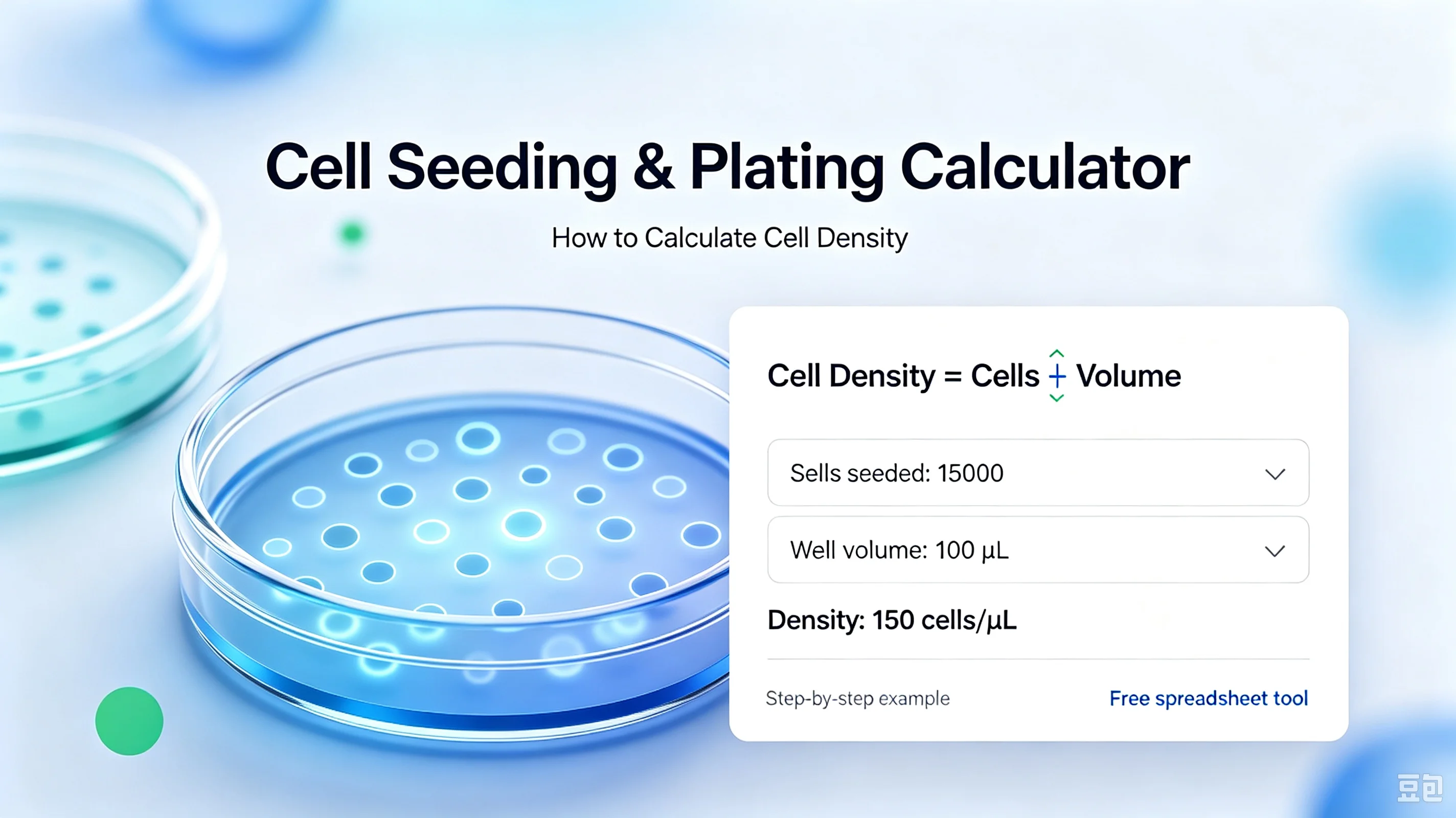
This guide explains how to calculate cell density, how to determine the correct volume for seeding, and how to use a cell seeding and plating calculator to avoid mistakes.
If you work with mammalian cells, accurate cell seeding is one of the most important steps in any experiment. Whether you are maintaining a cell line, setting up a transfection, or running a viability assay, the number of cells you plate directly affects reproducibility and data quality.
Cell seeding density is the number of cells you place into a culture vessel, usually expressed as:
Cells per well (e.g., 50,000 cells/well)
Cells per cm² (e.g., 20,000 cells/cm²)
Cells per mL (e.g., 100,000 cells/mL)
The best format depends on your experiment. For multi-well plates, cells per well is easiest to work with. For comparing vessels of different sizes, cells per cm² is more useful.
Cell behavior depends heavily on cell density:
Too many cells can cause contact inhibition, nutrient depletion, and altered gene expression.
Too few cells can lead to slow growth, stress, and poor transfection efficiency.
Inconsistent seeding between wells or experiments creates high variability.
Using a cell seeding calculator helps you plate the same number of viable cells every time.
The basic calculation is:
Volume of cell suspension to add = (Desired cell number) / (Cell concentration in suspension)
If you know the concentration of your cell suspension and the number of cells you want to plate, you can calculate the volume to pipette.
Count your cells using a hemocytometer or automated counter.
Calculate the concentration of your cell suspension.
Decide the desired seeding number per well or per dish.
Calculate the volume needed using the formula above.
Adjust with fresh medium to reach the final culture volume.
Suppose you want to seed 200,000 cells per well in a 6-well plate. Each well will have a final volume of 2 mL.
Your cell suspension has a concentration of 1,000,000 cells/mL.
Volume = Desired cells / Concentration
Volume = 200,000 cells / 1,000,000 cells/mL
Volume = 0.2 mL = 200 µL
Final volume per well = 2 mL
Cell suspension volume = 0.2 mL
Medium to add = 2 mL − 0.2 mL = 1.8 mL
So for each well, you would add 200 µL of cell suspension and 1.8 mL of fresh medium.
Some protocols specify seeding density in cells per cm². This is useful when scaling between vessels.
Assume your protocol calls for 30,000 cells/cm². You are using a T-25 flask with a growth area of 25 cm².
Total cells = Seeding density × Growth area
Total cells = 30,000 cells/cm² × 25 cm²
Total cells = 750,000 cells
Your suspension concentration is 2,000,000 cells/mL.
Volume = Total cells / Concentration
Volume = 750,000 cells / 2,000,000 cells/mL
Volume = 0.375 mL = 375 µL
For a T-25 flask, the typical final volume is 5 mL.
Medium to add = 5 mL − 0.375 mL = 4.625 mL
To use the formulas above, you first need to know your cell suspension concentration. The most common method is counting with a hemocytometer.
Cells/mL = Average cell count per square × Dilution factor × 10,000
The factor 10,000 comes from the volume of one counting square: 1 mm × 1 mm × 0.1 mm = 0.1 mm³ = 10⁻⁴ mL.
You load your hemocytometer and count the four corner squares:
Square 1: 45 cells
Square 2: 50 cells
Square 3: 48 cells
Square 4: 52 cells
Average = (45 + 50 + 48 + 52) / 4 = 48.75 cells
Your cell suspension was diluted 1:2 with trypan blue before counting, so the dilution factor is 2.
Cells/mL = 48.75 × 2 × 10,000 = 975,000 cells/mL
If you used trypan blue, you can also calculate viability:
Viability (%) = (Live cells / Total cells) × 100
Only live cells should be counted when calculating seeding density.
A cell plating calculator automates these steps. Instead of manually calculating volumes for every plate or flask, you can:
Select your culture vessel (6-well, 12-well, 24-well, 96-well, T-25, T-75, etc.)
Enter the desired seeding density per well or per cm²
Enter your cell suspension concentration
Get the exact volume of cell suspension and medium to add
This is especially helpful when you are plating multiple vessels with different surface areas in the same experiment.
Culture VesselGrowth Area (cm²)Typical Medium Volume96-well plate0.32100–200 µL48-well plate0.95200–500 µL24-well plate1.9500–1000 µL12-well plate3.81–2 mL6-well plate9.52–3 mL35 mm dish8.72 mL60 mm dish214–5 mL100 mm dish5510–12 mLT-25 flask255–7 mLT-75 flask7515–20 mLT-175 flask17535–50 mL
These numbers are useful when you need to scale an experiment from a 6-well plate to a T-75 flask.
Sometimes you will see protocols written as split ratios instead of exact cell numbers. A split ratio tells you how much to dilute a confluent culture when passaging.
For example:
1:3 split means you transfer one part of the cell suspension into a new vessel and add three parts of fresh medium.
1:10 split means one part cells plus nine parts medium.
To convert a split ratio to a seeding density, you can estimate:
Seeding density = Confluent cell density / Split ratio
If a confluent T-75 flask contains about 7.5 × 10⁶ cells, a 1:5 split would seed approximately:
7.5 × 10⁶ / 5 = 1.5 × 10⁶ cells per flask
However, exact cell numbers are more reproducible than split ratios, especially for sensitive assays.
Dead cells do not attach or proliferate. Always exclude them using trypan blue or another viability dye.
If you dilute your cells with trypan blue or medium before counting, multiply by the correct dilution factor. A 1:2 dilution is easy to forget.
These are not interchangeable. If you seed 50,000 cells/cm² in a 6-well plate, you are adding far more cells than 50,000 cells per well. Check your units carefully.
Cells settle quickly. If you take a sample from the bottom of the tube without mixing, you will overestimate or underestimate the concentration. Gently pipette up and down or vortex briefly before counting and plating.
Different manufacturers may have slightly different growth areas for the same vessel type. When scaling experiments, check the surface area on the manufacturer’s data sheet.
Decide how many cells you want per well or per cm². Divide that number by your cell suspension concentration to get the volume of suspension to add. Add fresh medium to reach the final culture volume.
It depends on the vessel and the assay. A common seeding density for HEK293 in a 6-well plate is 200,000–500,000 cells per well. For a 96-well plate, 10,000–20,000 cells per well is typical.
The terms are often used interchangeably. Cell seeding usually refers to the initial number of cells placed in a vessel, while cell plating may refer to the physical act of adding cells to the dish or plate. In practice, both mean placing cells into culture.
Use a hemocytometer: Cells/mL = average count per square × dilution factor × 10,000. Alternatively, use an automated cell counter that provides concentration directly.
After adding the cell suspension, gently rock the plate back and forth and side to side. Do not swirl in a circular motion, as this concentrates cells in the center. Let the plate sit undisturbed for a few minutes before moving it to the incubator.
You can use the free Cell Seeding & Plating Calculator on this site to quickly determine how much cell suspension and medium to add for any vessel.
How to use it:
Select your culture vessel or enter the surface area.
Enter your desired seeding density (cells per well or cells per cm²).
Enter your cell suspension concentration.
The calculator will show the exact volume of cell suspension and medium to add.
This tool is especially useful when you need to plate multiple plates, dishes, or flasks with different surface areas in the same experiment.
Accurate cell seeding is essential for reproducible cell culture experiments. By understanding the basic formulas and using a cell seeding and plating calculator, you can avoid common mistakes and ensure consistent results across wells, plates, and experiments.
Whether you are calculating cells per well, cells per cm², or converting a split ratio, the key is to know your cell concentration and the surface area of your culture vessel. With those two numbers, you can seed any vessel with confidence.
Try our free Cell Seeding & Plating Calculator and bookmark it for your next cell culture experiment.