This guide walks you through the process step by step, with clear examples and common pitfalls to avoid. You’ll also learn how to use a free chemical equation balancer to check your work instantly.
Balancing chemical equations is a fundamental skill in chemistry. Whether you are a student learning stoichiometry or a researcher preparing a reaction, a balanced equation tells you the exact proportions of reactants and products.
This guide walks you through the process step by step, with clear examples and common pitfalls to avoid. You’ll also learn how to use a free chemical equation balancer to check your work instantly.
A balanced chemical equation has the same number of each type of atom on both the reactant side and the product side. This follows the law of conservation of mass: atoms are neither created nor destroyed in a chemical reaction.
An unbalanced equation shows the correct formulas but incorrect ratios. A balanced equation uses coefficients (numbers placed before compounds) to adjust the amounts.
For example:
Unbalanced: H₂ + O₂ → H₂O
Balanced: 2H₂ + O₂ → 2H₂O
The balanced version shows two molecules of hydrogen reacting with one molecule of oxygen to produce two molecules of water.
A balanced equation is essential for:
Stoichiometry: Calculating how much product you can get from a given amount of reactant.
Laboratory work: Knowing the correct mole ratios for mixing reagents.
Predicting yields: Determining limiting reactants and theoretical yields.
Understanding reactions: Seeing how atoms rearrange during a chemical change.
Without a balanced equation, any quantitative calculation is impossible.
You can balance most simple equations using the inspection method — adjusting coefficients by trial and error while following a logical order.
Write the correct chemical formulas for all reactants and products. Do not change subscripts; only coefficients can be adjusted.
Example:
Fe + O₂ → Fe₂O₃
Make a table to compare the number of atoms of each element.
ElementReactantsProductsFe12O23
Start with an element that appears in only one reactant and one product. Balance it by placing a coefficient in front of the appropriate compound.
Balance Fe first:
2Fe + O₂ → Fe₂O₃
Now count again:
ElementReactantsProductsFe22O23
Oxygen is now unbalanced. Balance O by adding a coefficient before O₂. Because O₂ has 2 atoms and Fe₂O₃ has 3 oxygen atoms, the least common multiple is 6. That means we need 3 O₂ molecules and 2 Fe₂O₃ units.
4Fe + 3O₂ → 2Fe₂O₃
This changes Fe again, so rebalance Fe:
4Fe + 3O₂ → 2Fe₂O₃
Now check:
ElementReactantsProductsFe44O66
The equation is balanced.
Always count every element on both sides. If the numbers match, the equation is balanced. If not, adjust coefficients and recheck.
Unbalanced:
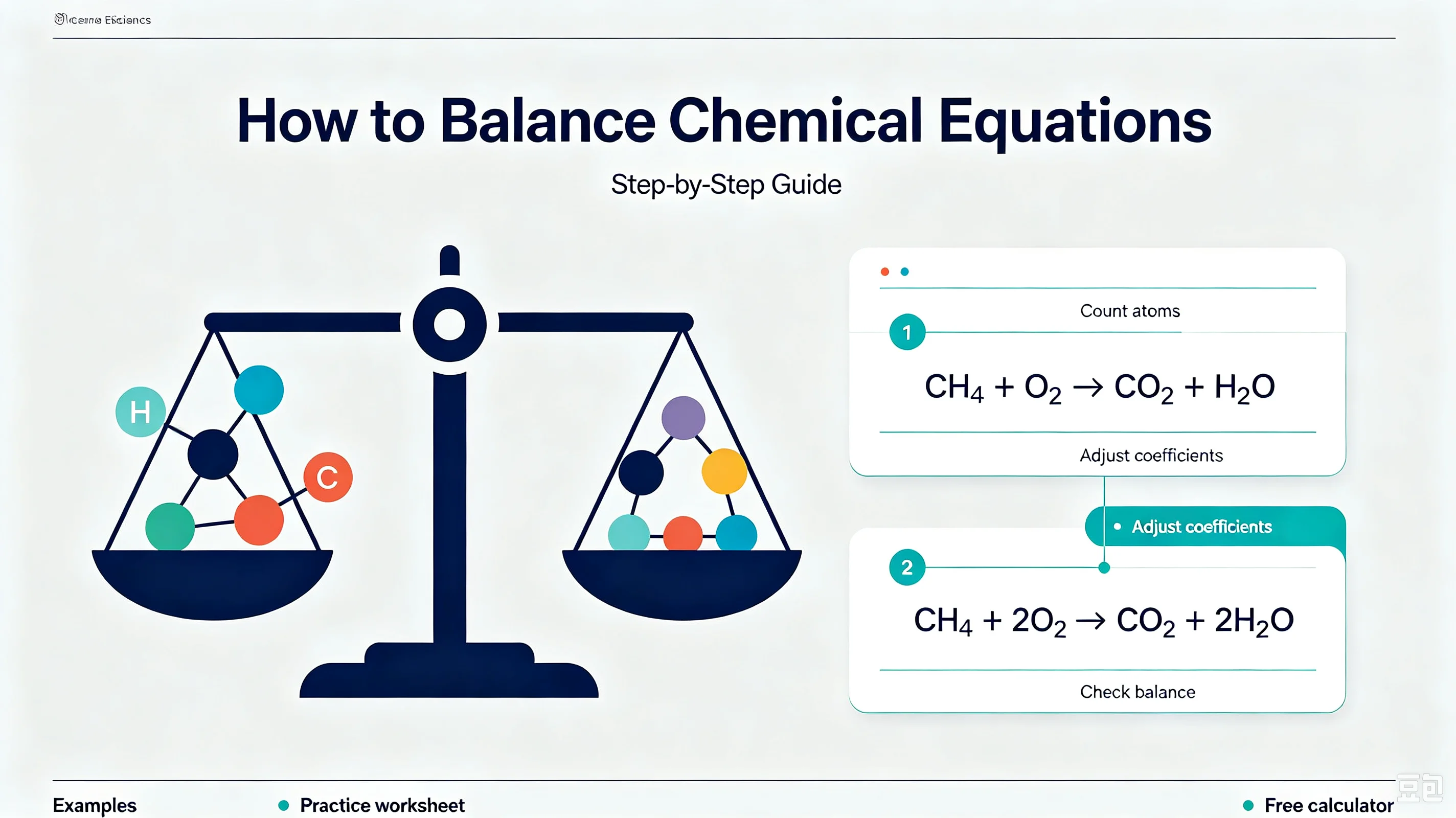
CH₄ + O₂ → CO₂ + H₂O
Count atoms:
ElementReactantsProductsC11H42O23
Carbon is already balanced. Balance hydrogen next by placing a 2 before H₂O:
CH₄ + O₂ → CO₂ + 2H₂O
Now count:
ElementReactantsProductsC11H44O24
Balance oxygen: we need 4 oxygen atoms on the reactant side, so place a 2 before O₂:
CH₄ + 2O₂ → CO₂ + 2H₂O
Final check:
ElementReactantsProductsC11H44O44
Balanced equation: CH₄ + 2O₂ → CO₂ + 2H₂O
When a polyatomic ion appears on both sides of the equation, treat it as a single unit if it does not change.
Unbalanced:
Al + H₂SO₄ → Al₂(SO₄)₃ + H₂
Count atoms/groups:
Group/ElementReactantsProductsAl12SO₄13H22
Balance Al by placing 2 before Al:
2Al + H₂SO₄ → Al₂(SO₄)₃ + H₂
Balance SO₄ by placing 3 before H₂SO₄:
2Al + 3H₂SO₄ → Al₂(SO₄)₃ + H₂
Now balance H: reactants have 3×2 = 6 H atoms, products have 2 H. Place 3 before H₂:
2Al + 3H₂SO₄ → Al₂(SO₄)₃ + 3H₂
Final check:
Group/ElementReactantsProductsAl22SO₄33H66
Balanced equation: 2Al + 3H₂SO₄ → Al₂(SO₄)₃ + 3H₂
Subscripts are part of the chemical formula and cannot be changed. For example, H₂O cannot become H₂O₂ just to balance oxygen atoms. Only coefficients (the numbers in front) can be adjusted.
Every time you add a coefficient, atom counts change for all elements in that compound. Recount after every adjustment.
It is usually easier to leave hydrogen and oxygen until last, because they often appear in multiple compounds. Balance metals and other elements first.
If all coefficients share a common factor, divide them by that factor. For example, 2H₂ + 2O₂ → 2H₂O can be simplified to 2H₂ + O₂ → 2H₂O.
If a polyatomic ion remains intact on both sides, balance it as one unit to save time.
Use the inspection method: write the unbalanced equation, count atoms, add coefficients one element at a time, leave hydrogen and oxygen for last, and check your work.
Most simple equations can be balanced by inspection. For complex redox reactions, you may need the half-reaction method or the algebraic method.
A coefficient is a number placed before a formula that multiplies the entire compound. A subscript is a small number within a formula that tells how many atoms of that element are in one molecule. Coefficients can be changed; subscripts cannot.
Because of the law of conservation of mass. Atoms are not created or destroyed, so the same number of each type of atom must appear on both sides.
Yes. A chemical equation balancer can balance simple and complex equations instantly. It is a great tool for checking your manual work or handling difficult reactions.
Use the free Chemical Equation Balancer on this site to balance any equation instantly.
How to use it:
Type or paste the unbalanced equation into the input box.
Click Balance.
Get the balanced equation with coefficients.
The tool handles combustion reactions, acid-base reactions, redox reactions, and more. It also shows the atom counts for verification.
Balancing chemical equations is a skill that improves with practice. By following a systematic step-by-step approach — count atoms, balance one element at a time, leave H and O for last, and always recheck — you can balance almost any equation quickly and accurately.
For difficult equations or when you need to save time, use the free Chemical Equation Balancer to check your work or balance reactions instantly.