This guide explains what a cell culture split ratio is, how to calculate it, how to convert a split ratio into an actual seeding density, and how to use a free split ratio calculator to save time and avoid mistakes.
Cell Culture Split Ratio Calculator: Formula & Examples
Passaging cells is a routine but critical task in any cell culture lab. Whether you are maintaining a cell line, expanding cells for an experiment, or freezing down stocks, the split ratio you choose determines how densely cells are seeded and how quickly they will grow back to confluence.
This guide explains what a cell culture split ratio is, how to calculate it, how to convert a split ratio into an actual seeding density, and how to use a free split ratio calculator to save time and avoid mistakes.
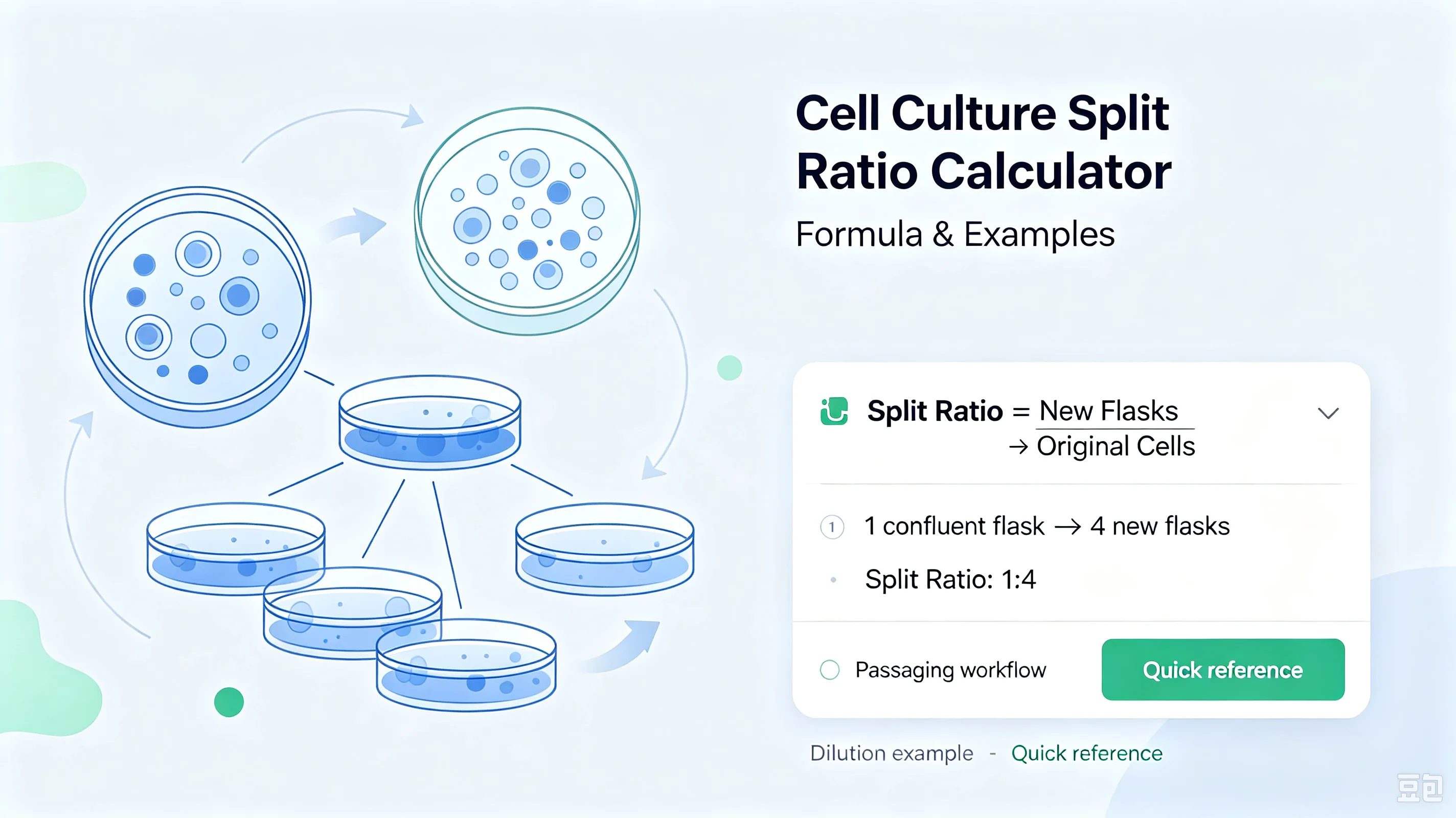
A split ratio (also called passage ratio or subculture ratio) describes how much you dilute a cell suspension when passaging cells. It is usually written as 1:X, where:
1 represents the portion of the existing cell suspension you carry over.
X represents the total number of portions after adding fresh medium.
For example, a 1:4 split means you take 1 part of the harvested cell suspension and add 3 parts of fresh medium, making 4 parts total. The cells have been diluted 4-fold compared with the original suspension.
Common split ratios include 1:2, 1:3, 1:5, and 1:10. The exact ratio depends on the growth rate of the cell line, the surface area of the new vessel, and how soon you need the cells to be confluent again.
Using the correct split ratio is important for several reasons:
Predictable growth timing: If you always split at the same ratio, you can predict when cells will reach confluence again.
Avoiding over-dilution: Splitting too aggressively can stress cells, slow their recovery, and reduce viability.
Avoiding over-confluence: Splitting too conservatively means cells may become confluent too soon, leading to contact inhibition or unwanted differentiation.
Reproducibility: Consistent split ratios help maintain consistent cell behavior across experiments.
A split ratio calculator helps you standardize this process by calculating the volumes of cell suspension and fresh medium needed for any vessel.
The split ratio is essentially a dilution factor. The relationship can be expressed as:
Split ratio = Total final volume / Volume of cell suspension transferred
Or, if you know the desired split ratio, the volume of cell suspension to transfer is:
Volume of cell suspension = Total final volume / Split ratio
For example, if you want a 1:5 split and the final culture volume in the new flask is 10 mL:
Volume of cell suspension = 10 mL / 5 = 2 mL
Then add fresh medium to reach 10 mL:
Fresh medium = 10 mL − 2 mL = 8 mL
This is the simplest way to use a split ratio. However, this calculation assumes you are working with a single harvested cell suspension and transferring a volume directly into a new vessel.
A split ratio alone does not tell you the exact number of cells you are seeding. To convert a split ratio into a seeding density, you need to know the total number of cells in the harvested suspension.
Count the harvested cell suspension to get its concentration (cells/mL).
Calculate the total number of cells in the suspension:
Total cells = Concentration × Total volume of suspension
Calculate the number of cells transferred:
Cells transferred = Total cells / Split ratio
Divide by the surface area of the new vessel to get cells/cm²:
Seeding density = Cells transferred / Surface area
You harvest a confluent T-75 flask and resuspend the cells in 10 mL of medium. The cell count is 1,000,000 cells/mL.
Total cells = 1,000,000 cells/mL × 10 mL = 10,000,000 cells
You perform a 1:5 split into a new T-75 flask. The number of cells transferred is:
Cells transferred = 10,000,000 / 5 = 2,000,000 cells
The surface area of a T-75 flask is 75 cm², so the seeding density is:
Seeding density = 2,000,000 cells / 75 cm² = 26,667 cells/cm²
This is a typical seeding density for many adherent cell lines.
Let’s work through a complete passaging example.
You have a confluent T-75 flask of HEK293 cells. You want to split them 1:8 into new T-75 flasks. You harvest the cells and resuspend them in 10 mL of complete medium.
For each new T-75 flask, the final volume will be 12 mL.
Volume of cell suspension = Final volume / Split ratio
Volume of cell suspension = 12 mL / 8 = 1.5 mL
Fresh medium = 12 mL − 1.5 mL = 10.5 mL
You have 10 mL of cell suspension. Each flask requires 1.5 mL.
Number of flasks = 10 mL / 1.5 mL = 6.67
So you can seed 6 full flasks (using 9 mL of suspension) and have 1 mL left over for another flask if you add more medium or for a smaller vessel.
Your original T-75 flask contained approximately 7.5 × 10⁶ cells at confluence (a useful rule of thumb for many adherent lines). After resuspending in 10 mL:
Concentration = 7,500,000 cells / 10 mL = 750,000 cells/mL
Each new flask receives 1.5 mL of suspension:
Cells transferred = 1.5 mL × 750,000 cells/mL = 1,125,000 cells per flask
Seeding density = 1,125,000 cells / 75 cm² = 15,000 cells/cm²
This seeding density should allow the cells to reach confluence in about 3–4 days, depending on the growth rate.
The table below shows approximate cell yields for common culture vessels at 100% confluence for typical adherent mammalian cell lines. These numbers help you estimate total cells without counting every time.
Culture VesselGrowth Area (cm²)Approximate Cells at Confluence96-well plate0.323 × 10⁴ – 8 × 10⁴24-well plate1.92 × 10⁵ – 4 × 10⁵12-well plate3.84 × 10⁵ – 8 × 10⁵6-well plate9.51 × 10⁶ – 2 × 10⁶35 mm dish8.71 × 10⁶ – 2 × 10⁶60 mm dish212 × 10⁶ – 4 × 10⁶100 mm dish555 × 10⁶ – 1 × 10⁷T-25 flask252.5 × 10⁶ – 5 × 10⁶T-75 flask757.5 × 10⁶ – 1.5 × 10⁷T-175 flask1751.5 × 10⁷ – 3 × 10⁷
Keep in mind that these numbers vary by cell type. Large, slow-growing cells may reach confluence at lower densities, while small, fast-growing cells may reach higher densities.
A 1:2 split does not mean you take half the final volume of cell suspension. It means you take 1 part cells plus 1 part medium, so the cell suspension is half of the total. For example, in a 10 mL final volume, a 1:2 split uses 5 mL of cell suspension and 5 mL of medium.
If cells settle to the bottom of the tube before you transfer them, the concentration in the transferred volume will be incorrect. Always mix gently before pipetting.
Different cell lines grow at different rates. A 1:10 split may be fine for fast-growing HEK293 cells but too harsh for slow-growing primary cells. Check the recommended split ratio for your specific cell line.
If your harvested cells have low viability, a standard split ratio will seed fewer live cells than expected. Always check viability and adjust the split ratio or cell count accordingly.
If you split from a T-25 flask into a T-75 flask, the surface area is 3 times larger. Simply using the same split ratio may not give the same seeding density. Calculate cells/cm² when changing vessel sizes.
A 1:3 split means you take 1 part of the cell suspension and add 2 parts of fresh medium, making 3 parts total. For example, 2 mL of cell suspension plus 4 mL of medium would be a 1:3 split if the final volume is 6 mL.
Choose a split ratio based on how quickly your cells grow and how soon you need them to be confluent. Fast-growing lines like HEK293 can often be split 1:8 to 1:10. Slow-growing or primary cells may need 1:2 or 1:3.
Yes, many labs use split ratios for routine maintenance without counting cells every time. However, for critical experiments, it is better to count cells and seed an exact number to improve reproducibility.
A split ratio tells you the dilution factor during passaging. Seeding density tells you the actual number of cells per well or per cm². A split ratio does not guarantee a specific seeding density unless you know the total cell number.
If the new vessel has a different surface area, adjust the volume of cell suspension proportionally. For example, if you normally use a 1:4 split into a T-75 flask (75 cm²) and now want to seed a T-25 flask (25 cm²), you need 1/3 of the cells because the surface area is 1/3. You can calculate the exact volume using the split ratio formula or a calculator.
You can use the free Cell Culture Split Ratio Calculator on this site to quickly determine the volumes of cell suspension and fresh medium needed for any split ratio and vessel.
How to use it:
Select your current vessel and target vessel (or enter surface areas).
Enter the desired split ratio (e.g., 1:4).
Enter the volume of your harvested cell suspension.
The calculator will show how much cell suspension and medium to add per new vessel, and how many vessels you can seed.
If you also count your cells, you can enter the concentration to see the exact seeding density and total cells transferred.
The cell culture split ratio is a simple but powerful tool for passaging cells reproducibly. Whether you follow a fixed ratio for routine maintenance or convert it to an exact seeding density for critical experiments, understanding the underlying calculation helps you avoid mistakes and keep your cells healthy.
Use the free Cell Culture Split Ratio Calculator to streamline your passaging workflow and ensure consistent cell densities every time.