In this guide, you’ll learn what a reverse complement is, why it matters, how to calculate it manually, and how to use a free online tool to do it instantly.
If you work with DNA sequences, you have likely needed to convert a sequence into its reverse complement. The reverse complement of a DNA strand is the sequence read in the opposite direction, with every base replaced by its complementary base. This simple operation is essential for PCR primer design, cloning, and many other molecular biology workflows.
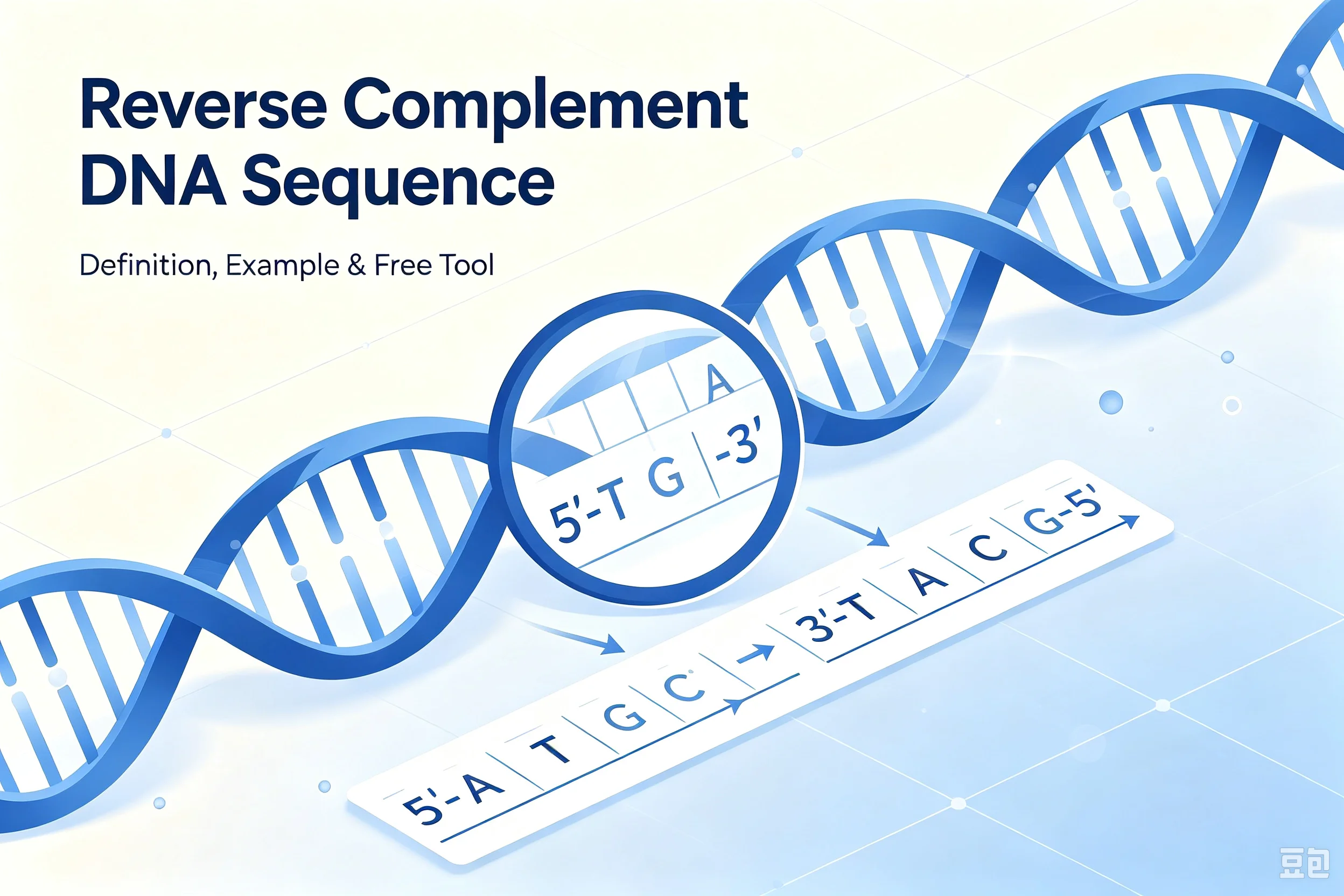
DNA is double-stranded and antiparallel. One strand runs 5′ to 3′, while the opposite strand runs 3′ to 5′. The two strands are held together by complementary base pairing:
A pairs with T
G pairs with C
The reverse complement of a DNA sequence is produced by two steps:
Reverse the order of the bases.
Replace each base with its complementary base.
For example, for the sequence:
5′-ATGC-3′
Reverse: 5′-CGTA-3′
Complement: 5′-GCAT-3′
So, the reverse complement of 5′-ATGC-3′ is 5′-GCAT-3′.
The same result can be obtained in either order — complement first then reverse, or reverse first then complement.
When designing a reverse primer for PCR, you must target the reverse complement of the template strand region. A reverse primer binds to the opposite strand and extends toward the forward primer. If you use the wrong sequence orientation, your primer will not anneal correctly.
Many restriction enzyme recognition sites are palindromic. For example, EcoRI recognizes:
5′-GAATTC-3′
Its reverse complement is also 5′-GAATTC-3′. Understanding reverse complements helps you confirm insertion orientation and verify that your insert is ligated in the correct direction.
Genes can be located on either strand of a genome. When you find an open reading frame on the reverse strand, you often need the reverse complement of the displayed sequence to work with the coding sequence in the 5′ to 3′ orientation.
Reverse complement sequences are used to design antisense probes, siRNA, and other oligonucleotides that must pair with a target RNA or DNA sequence.
Let’s calculate the reverse complement of a longer sequence:
Original sequence:
5′-ATG CGT AAT TGC-3′
ATG CGTAATTGC
Original: A T G C G T A A T T G C
Reversed: C G T T A A T G C G T A
C → G
G → C
T → A
T → A
A → T
A → T
T → A
G → C
C → G
G → C
T → A
A → T
The reverse complement is:
5′-GCA ATT ACG CAT-3′
For very short sequences, manual calculation is easy. For long sequences — such as whole plasmid inserts or primer sets — an online tool is faster and avoids errors.
Let’s look at a practical PCR example.
Suppose your template sequence contains:
Forward primer binding site:
5′-ATGGCTAGCTAG-3′
Target region:
...ATGGCTAGCTAG...
The reverse primer must bind to the opposite strand downstream of this site. If the reverse primer target sequence on the template strand is:
5′-TTAGCGTACGTA-3′
Then the reverse primer sequence you order should be its reverse complement:
5′-TACGTACGCTAA-3′
This ensures the primer anneals in the correct orientation and extends back toward the forward primer.
Some people reverse the sequence but forget to replace bases with complements. A reversed-only sequence will not pair with the original template.
By convention, DNA sequences are written 5′ to 3′ unless stated otherwise. Always output the reverse complement in the 5′ to 3′ direction.
If you are reverse complementing an RNA sequence, replace U with A, A with U, G with C, and C with G. Do not use T for RNA.
If your sequence contains ambiguous bases such as N, R, Y, S, W, K, M, B, D, H, V, the reverse complement tool should either keep them or convert them according to IUPAC codes. For example, R (A or G) is complemented by Y (C or T). Check your tool’s behavior if you work with degenerate primers.
No. Reverse only flips the order of bases. Reverse complement flips the order and replaces each base with its complementary base. For 5′-ATGC-3′, the reverse is 5′-CGTA-3′, while the reverse complement is 5′-GCAT-3′.
The complement replaces each base with its partner but keeps the original 5′ to 3′ direction. The reverse complement also reverses the sequence. For 5′-ATGC-3′, the complement is 5′-TACG-3′, while the reverse complement is 5′-GCAT-3′.
Because DNA polymerases synthesize DNA only in the 5′ to 3′ direction, and most software and databases use 5′ to 3′ as the standard orientation. Writing the reverse complement 5′ to 3′ makes it directly usable for primer synthesis and sequence alignment.
Yes. For RNA, replace A↔U and G↔C after reversing the sequence. For example, the reverse complement of 5′-AUGC-3′ is 5′-GCAU-3′.
Most online reverse complement tools automatically ignore spaces, numbers, and line breaks, and accept uppercase or lowercase letters. The output is usually returned in uppercase.
You can calculate the reverse complement of any DNA sequence instantly with the free Reverse Complement Tool on this site.
How to use it:
Paste your DNA sequence into the input box.
Click Reverse Complement.
Copy the result in 5′ to 3′ orientation.
The tool handles long sequences, ignores spaces and numbers, and works with both DNA and RNA. If you need to reverse complement multiple primers or sequences, simply paste them one at a time or use a batch mode if available.
Use the tool alongside this guide whenever you design PCR primers, check cloning orientations, or work with reverse-strand genes.
The reverse complement of a DNA sequence is a fundamental concept in molecular biology. It is required for PCR primer design, cloning, and antisense work. You can calculate it manually by reversing the sequence and replacing bases with their complements — but for accuracy and speed, a dedicated reverse complement tool is the better choice.
Try our free Reverse Complement Tool today and bookmark it for your next experiment.