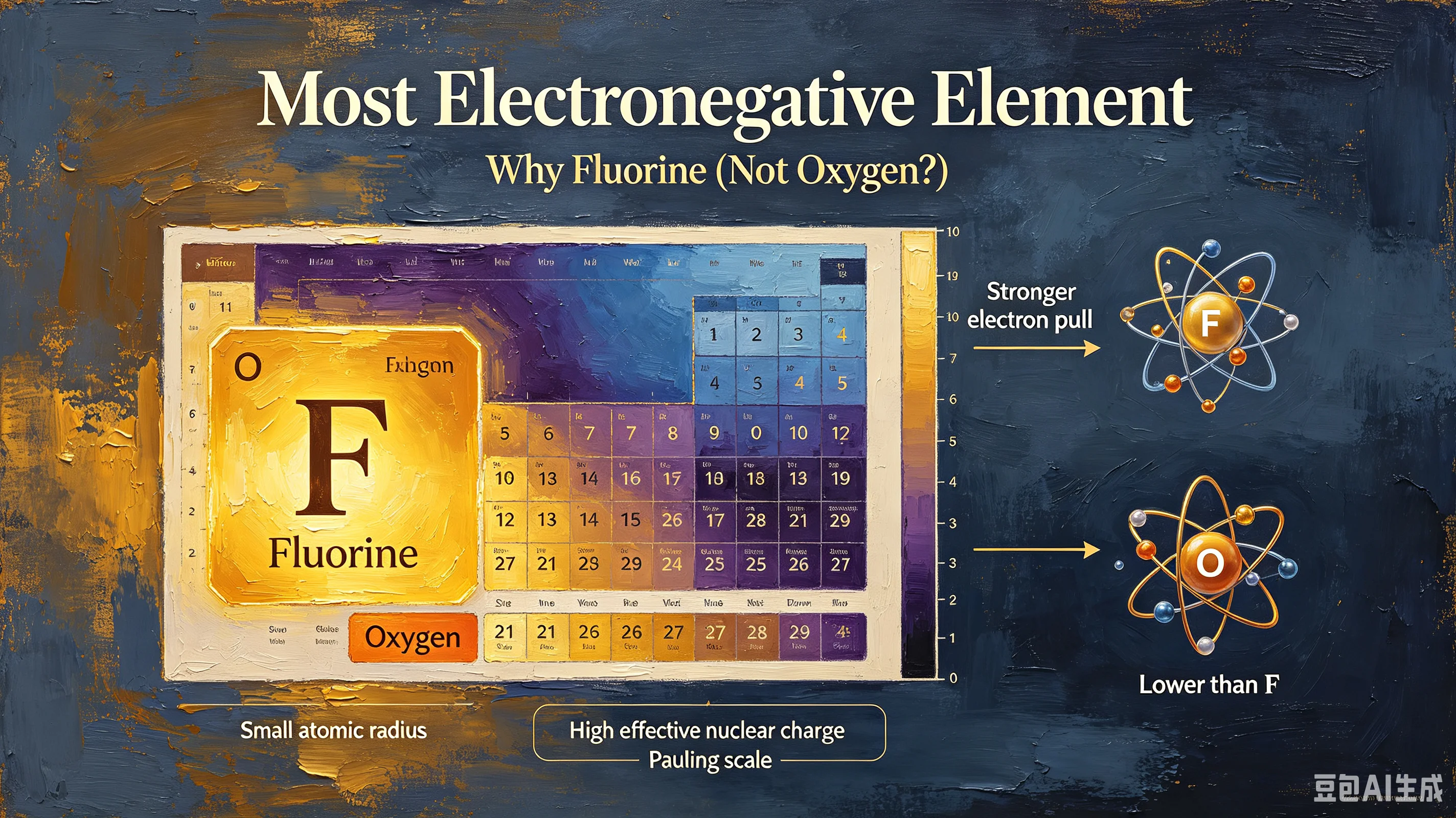
Fluorine is the most electronegative element (3.98 Pauling), not oxygen (3.44). Learn why fluorine beats oxygen on the periodic table, the chemistry of F's extreme electron greed, and the top 10 most electronegative elements ranked. Interactive electronegativity heatmap included.
Ask someone which element is the most electronegative, and a surprising number will say oxygen. It's everywhere — in water, in air, in every breath. It oxidizes things, it's reactive, it feels like the obvious answer. But it's wrong. Fluorine is the most electronegative element, with a Pauling value of 3.98, compared to oxygen's 3.44. The gap isn't small — it's larger than the gap between oxygen and nitrogen (3.04). This guide explains exactly why fluorine wins, why so many people guess oxygen, and what fluorine's extreme electronegativity means for chemistry.
The Numbers: Top 10 Most Electronegative Elements
Before the "why," here are the top 10 on the Pauling scale:
Rank | Element | Symbol | Electronegativity | Electron Config |
|---|---|---|---|---|
1 | Fluorine | F | 3.98 | [He] 2s² 2p⁵ |
2 | Oxygen | O | 3.44 | [He] 2s² 2p⁴ |
3 | Chlorine | Cl | 3.16 | [Ne] 3s² 3p⁵ |
4 | Nitrogen | N | 3.04 | [He] 2s² 2p³ |
5 | Krypton | Kr | 3.00 | [Ar] 3d¹⁰ 4s² 4p⁶ |
6 | Bromine | Br | 2.96 | [Ar] 3d¹⁰ 4s² 4p⁵ |
7 | Iodine | I | 2.66 | [Kr] 4d¹⁰ 5s² 5p⁵ |
8 | Sulfur | S | 2.58 | [Ne] 3s² 3p⁴ |
9 | Carbon | C | 2.55 | [He] 2s² 2p² |
10 | Selenium | Se | 2.55 | [Ar] 3d¹⁰ 4s² 4p⁴ |
Fluorine sits alone at the top. The 0.54 gap between F and O is bigger than the gap between O (3.44) and Cl (3.16), and bigger than between Cl and N. Fluorine isn't just number one — it's a clear outlier.
Why Fluorine Beats Oxygen
Electronegativity depends on two competing factors: nuclear charge (more protons = stronger pull) and atomic radius (larger atom = electrons farther from nucleus = weaker pull). Fluorine wins on both counts relative to oxygen.
1. Fluorine has one more proton.
Oxygen has 8 protons; fluorine has 9. That extra proton increases the nuclear charge pulling on bonding electrons. Across Period 2, every step right adds a proton — and electronegativity climbs accordingly: Li (0.98) → Be (1.57) → B (2.04) → C (2.55) → N (3.04) → O (3.44) → F (3.98). Fluorine is simply further right than oxygen, so it has a stronger nucleus.
2. Fluorine is smaller.
Fluorine's covalent radius is ~71 pm; oxygen's is ~73 pm. Both are in the same period (same electron shells), but fluorine's extra proton pulls electrons closer. Smaller radius means bonding electrons sit nearer the nucleus, where the attractive force is stronger.
3. Fluorine is one electron from a full shell.
Fluorine's configuration is [He] 2s² 2p⁵ — it needs just one electron to reach the stable neon configuration (2s² 2p⁶). Oxygen is [He] 2s² 2p⁴ — it needs two electrons. The drive to complete the valence shell is stronger when you're only one electron away. Fluorine's 2p⁵ configuration is "hungrier" than oxygen's 2p⁴.
4. Fluorine has less electron-electron repulsion.
Wait — shouldn't fluorine's extra electron mean more repulsion? In oxygen's 2p⁴, one p orbital has a paired electron (↑↓), creating repulsion. Fluorine's 2p⁵ has two paired orbitals, but the higher nuclear charge more than compensates. The net effect: fluorine's outer electrons are held tighter despite the extra electron.
The combined result: fluorine pulls bonding electrons harder than any other element. In any F–X bond, the electron density is skewed toward fluorine, making fluorine δ⁻ and the other atom δ⁺.
Why Everyone Guesses Oxygen
If fluorine is so clearly number one, why do so many people — even some science students — say oxygen?
1. Oxygen is more familiar.
Oxygen is 21% of the atmosphere, essential for respiration, and the central atom in water. Fluorine is a pale yellow gas you've probably never seen in person. Familiarity breeds assumption.
2. "Oxidation" is named after oxygen.
The word "oxidation" literally means "combination with oxygen," and oxygen is the classic oxidizing agent. People associate oxygen with electron-grabbing because the concept is named after it. But fluorine is actually a stronger oxidizing agent than oxygen — it just wasn't discovered first.
3. Oxygen forms more bonds in everyday chemistry.
Oxygen forms two bonds (in water, CO₂, alcohols, ethers), so it appears constantly in organic and biological chemistry. Fluorine forms one bond and is relatively rare in biological systems. You encounter oxygen's electron-grabbing behavior far more often.
4. Oxygen is more reactive in everyday experience.
Iron rusts (reacts with oxygen), wood burns (reacts with oxygen), food spoils (oxidation). Fluorine is so reactive that it's rarely encountered outside a lab — it reacts with almost everything, including glass and water, so it's stored in special containers. Its very reactivity makes it invisible to daily life.
5. Some textbooks emphasize oxygen.
Biology and biochemistry courses focus heavily on oxygen (respiration, photosynthesis, oxidative phosphorylation). Chemistry courses mention fluorine's electronegativity, but if you remember only from biology class, oxygen feels like the most "electron-hungry" element.
What Fluorine's Extreme Electronegativity Does
Fluorine's number-one ranking isn't just a trivia fact — it drives some of the most extreme chemistry in the periodic table.
Fluorine oxidizes oxygen.
In oxygen difluoride (OF₂), oxygen has an oxidation state of +2 and fluorine is -1. Fluorine literally steals electrons from oxygen — the element most people think is the ultimate oxidizer. This is the clearest proof that fluorine > oxygen.
Fluorine reacts with almost everything.
Fluorine gas reacts with all elements except helium, neon, and argon. It etches glass (reacts with SiO₂), reacts violently with water (producing HF and O₂), and even forms compounds with noble gases: XeF₂, XeF₄, XeF₆, KrF₂, and RnF₂. No other element can pull electrons from xenon — but fluorine can.
Fluorine forms the strongest single bonds.
The H–F bond (569 kJ/mol) is the strongest single bond involving hydrogen. The C–F bond (485 kJ/mol) is one of the strongest in organic chemistry, which is why Teflon (polytetrafluoroethylene) is so chemically inert — those C–F bonds are nearly unbreakable.
HF is a weak acid (counterintuitively).
You'd expect the most electronegative element to form the strongest acid. But HF is weak in water (pKa ≈ 3.2) because the H–F bond is so strong that it doesn't dissociate easily. HCl, HBr, and HI are all strong acids despite their halogens being less electronegative — because their H–X bonds are weaker. Electronegativity isn't the only factor in acidity; bond strength matters too.
Fluoride is the most electronegative ion.
F⁻ has a full octet and a tiny ionic radius (133 pm), making it the most charge-dense anion. This is why fluoride is used in toothpaste (it reacts with tooth enamel hydroxyapatite to form stronger fluorapatite) and why hydrofluoric acid is so dangerous (F⁻ penetrates tissue and binds calcium in bones).
Fluorine stabilizes high oxidation states.
Because fluorine pulls electrons so hard, it can stabilize elements in unusually high oxidation states: AgF₂ (Ag²⁺), AuF₅ (Au⁵⁺), PtF₆ (Pt⁶⁺), and even HgF₄ (Hg⁴⁺, a rare +4 oxidation state for mercury). Oxygen can do this too, but fluorine goes further — PtF₆ was the compound used to make the first noble gas compound (XePtF₆) because it's such a strong oxidizer.
The Electronegativity Trend at a Glance
Fluorine's position at the top is the peak of a broader diagonal trend: electronegativity increases up and to the right of the periodic table.
Across a period (left to right): More protons, same shell → higher Zeff → higher electronegativity.
Down a group (top to bottom): More electron shells, larger radius → lower electronegativity.
This puts fluorine (top-right, excluding noble gases) at the absolute peak. The noble gases (He, Ne, Ar) are usually excluded because they rarely form bonds — but krypton (3.00) and xenon (2.60) do have measured electronegativities because they can form compounds with fluorine.
An electronegativity heatmap makes this instantly visible: fluorine glows the warmest red, and the color fades diagonally toward the bottom-left (francium, 0.70, is the coolest blue). You can see the F > O > N > C trend across Period 2, and the F > Cl > Br > I trend down Group 17, without reading a single number.
Common Questions
Is fluorine really more electronegative than oxygen?
Yes, by a significant margin: 3.98 vs. 3.44 on the Pauling scale. This is consistent across all electronegativity scales (Pauling, Mulliken, Allen, Allred-Rochow). Fluorine is number one on every scale.
Why doesn't fluorine have the highest electron affinity?
Electron affinity is different from electronegativity. Chlorine actually has a higher electron affinity (349 kJ/mol) than fluorine (328 kJ/mol) because fluorine is so small that the incoming electron experiences significant repulsion from existing electrons. Electronegativity describes attraction in a bond, while electron affinity is the energy of adding an electron to a free atom. They correlate but aren't identical.
Can fluorine ever be positive?
In normal chemistry, no — fluorine is always -1 in compounds. The only exception is in exotic species like F₂⁺ (fluorine cation) created in mass spectrometers or plasma. In any stable compound you'll encounter in a lab, fluorine is -1.
What about the Allen scale? Does it change the ranking?
The Allen scale (based on spectroscopic data) also puts fluorine first: F = 4.193, O = 3.610, N = 3.066, Cl = 2.869. The ranking is identical to Pauling. Fluorine's top position is scale-independent.
Why is fluorine more electronegative than chlorine if chlorine has more protons?
Chlorine has 17 protons vs. fluorine's 9, but chlorine is much larger (covalent radius 99 pm vs. 71 pm) because its outer electrons are in the 3rd shell, farther from the nucleus. The distance effect dominates — fluorine's bonding electrons are much closer to its nucleus, so they feel a stronger pull despite the smaller nuclear charge.
Is there any element that could beat fluorine?
Not among known elements. Theoretically, element 119 (ununennium, below francium) would have the lowest electronegativity, not the highest. The top-right corner is occupied by fluorine, and there's no element above or to the right of it that forms bonds. Helium and neon are above fluorine but don't form bonds, so they have no measurable electronegativity.
Start Exploring
Open the chembioTube Interactive Periodic Table and switch to the electronegativity heatmap. Watch fluorine glow the deepest red at the top-right, click it for its Pauling value (3.98), and compare side-by-side with oxygen (3.44) and chlorine (3.16). See the full diagonal trend across all 118 elements. Free, no signup, runs in your browser.