Every element has a phase diagram mapping solid, liquid, and gas states across temperature and pressure. Explore melting points, boiling points, triple points, and sublimation with an interactive temperature slider. Covers carbon, helium, mercury, and all 118 elements.
Water freezes at 0°C and boils at 100°C — but only at sea level. Every element has its own phase diagram: a map of whether it's solid, liquid, or gas at any given temperature and pressure. Some elements behave predictably; others are bizarre — carbon skips the liquid phase entirely at normal pressure, helium never freezes without squeezing, and only two elements are liquid at room temperature. This guide explains how to read an element phase diagram, what triple points and critical points mean, how pressure changes everything, and how a temperature slider lets you explore all 118 elements at once.
The Three Phases and Phase Transitions
Every element can exist in three familiar phases:
Solid — atoms or molecules locked in a rigid lattice; fixed shape and volume
Liquid — particles close together but free to flow; fixed volume, variable shape
Gas — particles far apart and moving freely; variable shape and volume
Transitions between phases happen at specific temperatures (at a given pressure):
Melting point — solid → liquid
Boiling point — liquid → gas
Sublimation point — solid → gas directly (skipping liquid)
Freezing point — liquid → solid (same temperature as melting point)
Condensation point — gas → liquid (same temperature as boiling point)
For most elements at standard pressure (1 atm), the path is straightforward: heat a solid → it melts → heat more → it boils → it's a gas. But the temperatures vary enormously: from helium boiling at -268.9°C to rhenium boiling at 5,596°C — a span of nearly 5,900 degrees.
How to Read a Phase Diagram
A standard phase diagram plots temperature on the x-axis and pressure on the y-axis. Three lines divide the graph into three regions (solid, liquid, gas):
Sublimation curve (solid–gas boundary) — below this, solid turns directly to gas
Melting curve (solid–liquid boundary) — the melting point at each pressure
Vaporization curve (liquid–gas boundary) — the boiling point at each pressure
Where these lines meet is the triple point: the exact temperature and pressure where all three phases coexist in equilibrium. For water, the triple point is 0.01°C and 0.006 atm — that's why ice, liquid water, and water vapor can coexist only in a near-vacuum.
Where the vaporization curve ends is the critical point: above this temperature and pressure, liquid and gas become indistinguishable — a supercritical fluid. No amount of pressure will condense it back to liquid.
Most elements have a "normal" phase diagram shape, but two famous exceptions break the rules.
Carbon: No Liquid at Normal Pressure
At standard pressure (1 atm), carbon sublimes at approximately 3,600°C — it turns directly from solid to gas without ever becoming liquid. To get liquid carbon, you need extreme pressure: carbon's triple point is around 4,600°C and 10.8 MPa (about 107 atm). Below that pressure, there is no liquid phase at all.
This is why graphite and diamond don't melt in a fire — they vaporize. It's also why liquid carbon is one of the hardest substances to study in a lab: you need both extreme heat and extreme pressure simultaneously.
Helium: The Element That Never Freezes
Helium is the only element that remains liquid at absolute zero (−273.15°C) at standard pressure. Its interatomic forces are so weak that even at 0 K, quantum zero-point energy keeps the atoms moving. To solidify helium, you need at least 25 atmospheres of pressure — and even then, it freezes at just -272.2°C, barely above absolute zero.
Helium also has the lowest boiling point of any element: -268.9°C (4.2 K). Below 2.17 K, liquid helium becomes a superfluid — it flows without friction, climbs the walls of its container, and leaks through microscopic pores. This is a fourth state (a quantum fluid) not captured by the simple solid–liquid–gas model.
The Two Liquids at Room Temperature
At 25°C and 1 atm, exactly two elements are liquid:
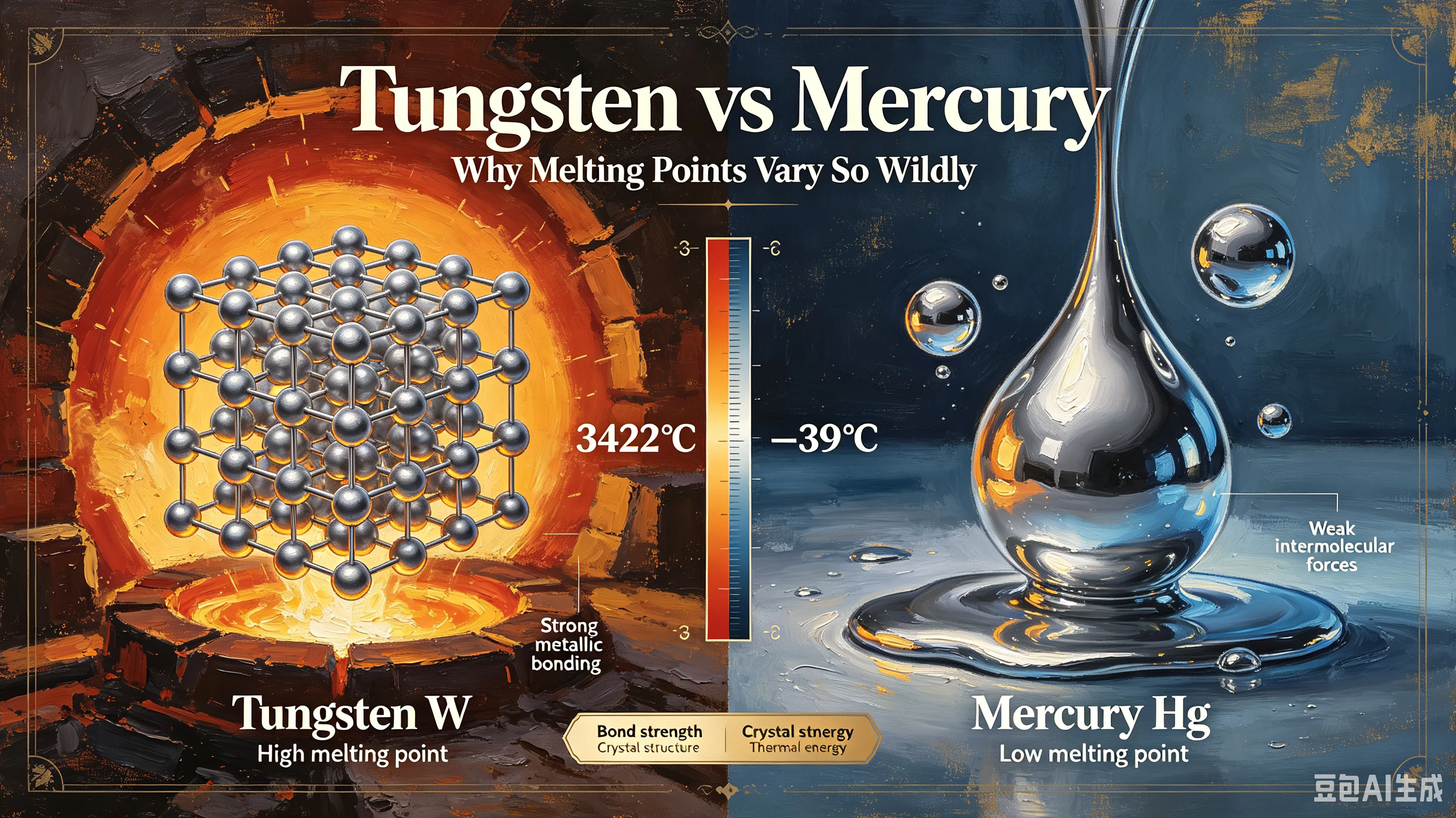
Mercury (Hg) — melts at -38.8°C, boils at 356.7°C. The only metal liquid at room temperature, thanks to weak metallic bonding from relativistic effects.
Bromine (Br) — melts at -7.2°C, boils at 58.8°C. The only nonmetal liquid at room temperature, a reddish-brown fuming liquid.
Four more elements melt just above room temperature: francium (~27°C), cesium (28.4°C), gallium (29.8°C), and rubidium (39.3°C). On a warm day or in your hand, gallium and cesium become liquid too.
Explore Any Temperature With a Slider
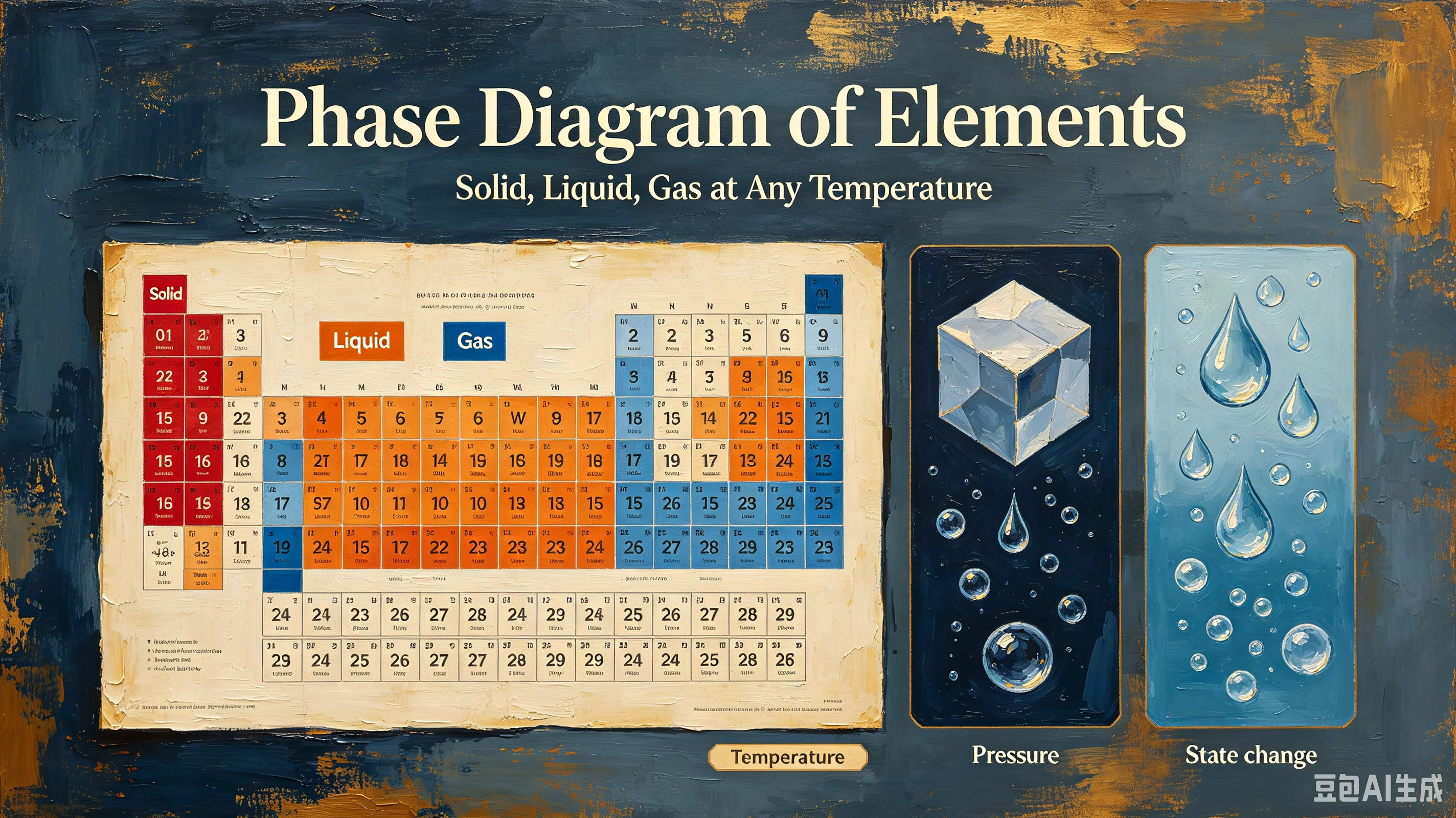
A static phase diagram shows one element at a time. An interactive periodic table with a temperature slider shows all 118 elements simultaneously — color-coded by phase at whatever temperature you set. Here's what you see at key milestones:
At -200°C: Most elements are solid. The exceptions: oxygen (melts -218°C, so still liquid at -200°C), nitrogen (melts -210°C, still liquid), neon (melts -249°C, still liquid), and hydrogen (melts -259°C, still liquid). Helium is the only gas (boils -269°C, so still gas at -200°C).
At 0°C: Mercury and bromine are liquid. Everything else is solid except the permanent gases (H, N, O, F, Cl, noble gases).
At 100°C: Mercury and bromine remain liquid (bromine boils at 59°C, so it's now gas — leaving only mercury). Gallium, cesium, francium, and rubidium have melted. Sodium (98°C) just melted. Most metals are still solid.
At 500°C: Roughly 15–20 elements are liquid, including all alkali metals (Li melts 180°C, Na 98°C, K 63°C, Rb 39°C, Cs 28°C), several post-transition metals, and some low-melting transition metals.
At 1,000°C: About 40+ elements are liquid — aluminum (660°C), gold (1,064°C), silver (962°C), copper (1,085°C). Iron (1,538°C) is still solid.
At 3,000°C: Most metals have melted. Only tungsten (3,422°C), rhenium (3,186°C — just melted), osmium (3,033°C — just melted), and tantalum (3,017°C — just melted) remain solid, plus carbon (sublimes at ~3,600°C).
At 3,500°C: Tungsten has melted. Carbon is the only solid remaining — and it will sublime, not melt, at ~3,600°C.
At every step, the slider updates all 118 element tiles in real time, turning a table of 236 data points (118 melting + 118 boiling points) into a visual story.
How Pressure Changes the Phase Diagram
Temperature is only half the story. Pressure shifts every phase boundary:
Higher pressure raises the boiling point — this is why water boils at 121°C in a pressure cooker, and why liquid carbon exists only above 107 atm.
Higher pressure usually raises the melting point — squeezing atoms makes it harder for them to break free of the solid lattice. (Water is an exception: ice melts at lower temperature under pressure because ice is less dense than liquid water.)
Below the triple point pressure, liquid cannot exist — the element sublimates directly from solid to gas. This is why dry ice (solid CO₂) doesn't melt at room pressure, and why carbon has no liquid phase at 1 atm.
Above the critical point, liquid and gas merge into a supercritical fluid. Supercritical CO₂ is used for decaffeinating coffee; supercritical water is used for waste destruction.
For elements, the critical temperatures vary wildly: helium's critical point is -267.96°C (5.19 K) and 2.24 atm — barely above absolute zero. Tungsten's critical point is estimated above 10,000°C and thousands of atmospheres.
Why Element Phase Diagrams Matter
Materials science — choosing refractory metals for high-temperature applications (turbine blades, furnace linings) depends on melting points. Tungsten and rhenium are the go-to metals for extreme heat.
Cryogenics — liquid nitrogen (-196°C) and liquid helium (-269°C) are essential for superconductors, MRI machines, and quantum computing. Knowing their phase boundaries is critical for safe handling.
Industrial processes — smelting, distillation, and chemical vapor deposition all rely on precise control of element phase transitions.
Planetary science — gas giants like Jupiter have layers of metallic hydrogen (hydrogen becomes a conductive metal under extreme pressure), and their cores may contain supercritical fluids of elements we think of as gases.
Education — phase diagrams are the classic way to teach that "solid, liquid, gas" depends on both temperature AND pressure, not just temperature alone.
Common Questions
Can every element be a liquid?
At the right temperature and pressure, yes — except helium at standard pressure. Every element has a triple point where liquid can exist, though some (like carbon) require extreme pressure.
What is the most refractory element?
Tungsten has the highest melting point of any metal (3,422°C). Rhenium has the highest boiling point (5,596°C). Carbon sublimes at ~3,600°C at 1 atm but melts at ~4,600°C under high pressure.
Why does pressure raise boiling point?
Boiling happens when vapor pressure equals atmospheric pressure. Higher external pressure means the liquid needs a higher temperature to generate enough vapor pressure to boil. That's the pressure cooker principle.
What is a supercritical fluid?
Above the critical temperature and pressure, liquid and gas become a single phase with properties of both — density like a liquid, flow like a gas. It's not solid, liquid, or gas; it's a fourth state for practical purposes.
Do all elements have a triple point?
Yes, every element has a temperature and pressure where solid, liquid, and gas coexist. For some (like helium), the triple point is at extremely low temperature and pressure; for others (like carbon), it's at extremely high pressure.
Start Exploring
Open the chembioTube Interactive Periodic Table with the temperature slider. Drag from -273°C to 6,000°C and watch all 118 elements change phase in real time — solid, liquid, and gas color-coded instantly. Click any element for its melting point, boiling point, triple point, and critical point data. Free, no signup, runs in your browser.