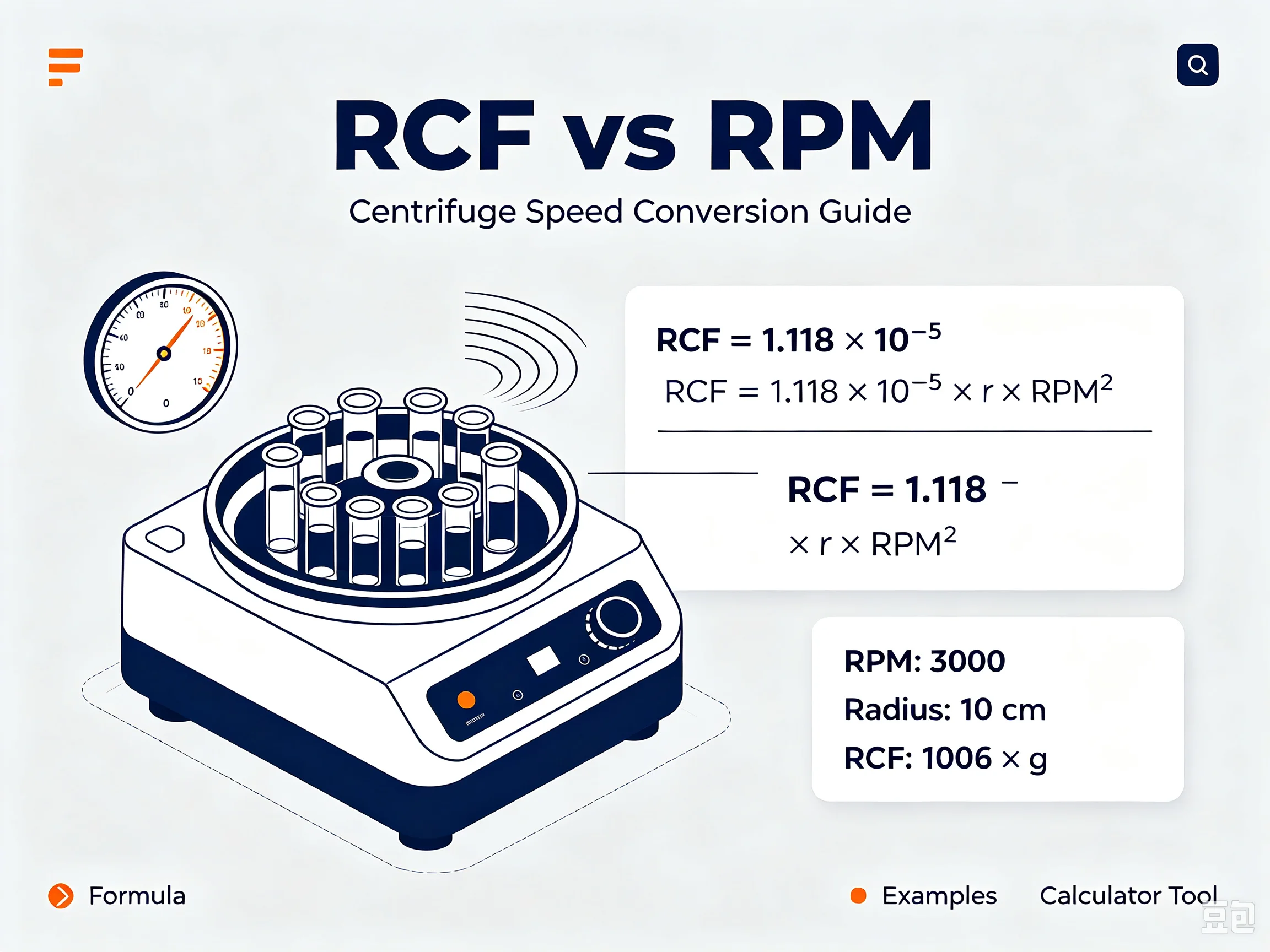
This guide explains what RPM and RCF mean, how to convert between them, why the rotor radius matters, and how to use a free centrifuge speed conversion calculator.
Centrifugation is a fundamental technique in biology, chemistry, and clinical labs. Yet one of the most common sources of confusion is the difference between RPM and RCF. Protocols often specify centrifugation conditions using one or the other, but they are not interchangeable — unless you know the rotor radius.
This guide explains what RPM and RCF mean, how to convert between them, why the rotor radius matters, and how to use a free centrifuge speed conversion calculator.
RPM stands for revolutions per minute. It is a measure of how fast the centrifuge rotor spins. RPM is a property of the centrifuge motor and rotor, but it does not directly tell you the force experienced by the sample.
Two centrifuges spinning at the same RPM can generate very different centrifugal forces if their rotors have different radii.
RCF stands for relative centrifugal force. It is the force exerted on a sample during centrifugation, expressed as a multiple of Earth’s gravitational force (g). RCF is sometimes written as ×g or simply g, but it is not the same as the gravitational constant — it is a relative value.
For example, an RCF of 500 ×g means the sample experiences a force 500 times greater than normal gravity.
Key point: RCF tells you the actual separation force applied to the sample. RPM only tells you how fast the rotor is spinning.
The formula to convert RPM to RCF is:
RCF = 1.118 × 10⁻⁵ × r × (RPM)²
Where:
RCF is the relative centrifugal force (×g)
r is the rotor radius in centimeters (cm)
RPM is the revolutions per minute
The constant 1.118 × 10⁻⁵ comes from the physics of circular motion and the conversion of angular velocity to linear acceleration.
To convert RCF back to RPM, rearrange the formula:
RPM = √[RCF / (1.118 × 10⁻⁵ × r)]
The rotor radius is the distance from the center of the rotor to the sample, usually measured in centimeters. Because RCF depends on the radius, the same RPM produces different RCF values on different rotors.
For example, at 10,000 RPM:
A small rotor with a radius of 5 cm produces 5,590 ×g
A large rotor with a radius of 15 cm produces 16,770 ×g
That is a threefold difference — enough to completely change your separation result.
Most centrifuge manufacturers print the rotor radius on the rotor itself or in the user manual. If you cannot find it, you can measure it:
Remove the rotor from the centrifuge.
Measure the distance from the center of the rotor to the middle of a sample tube when the tube is in place.
Record the value in centimeters.
Alternatively, many modern centrifuges allow you to enter the rotor radius and will display RCF directly. Some have automatic rotor identification.
A common protocol step is to spin cells at 300 ×g for 5 minutes. You have a centrifuge with a rotor radius of 10 cm.
Use the formula:
RPM = √[RCF / (1.118 × 10⁻⁵ × r)]
RPM = √[300 / (1.118 × 10⁻⁵ × 10)]
RPM = √[300 / 0.0001118]
RPM = √[2,683,363]
RPM ≈ 1,638
So you would set the centrifuge to approximately 1,640 RPM.
A protocol specifies 1,500 ×g for 10 minutes. Your rotor radius is 8 cm.
RPM = √[1500 / (1.118 × 10⁻⁵ × 8)]
RPM = √[1500 / 0.00008944]
RPM = √[16,771,813]
RPM ≈ 4,095
You would set the centrifuge to approximately 4,100 RPM.
Your centrifuge is set to 10,000 RPM, and the rotor radius is 12 cm.
RCF = 1.118 × 10⁻⁵ × 12 × (10,000)²
RCF = 1.118 × 10⁻⁵ × 12 × 100,000,000
RCF = 1.118 × 12 × 1000
RCF = 13,416 ×g
In centrifugation, RCF and ×g are used interchangeably. When a protocol says “spin at 10,000 ×g,” it means an RCF of 10,000 times the standard acceleration due to gravity.
However, it is technically more correct to say RCF because the force is relative to Earth’s gravity. The symbol “g” alone refers to the gravitational acceleration constant (9.81 m/s²). RCF expresses the centrifugal acceleration as a multiple of that constant.
Is RCF the same as g?
In everyday lab usage, yes. If a protocol says 500 g, 500 ×g, or 500 RCF, they all mean the same thing — a relative centrifugal force of 500 times gravity.
RCF is a dimensionless number because it is a ratio of centrifugal acceleration to gravitational acceleration. However, it is commonly written with units of ×g or g to indicate the multiplication factor.
For example:
100 RCF = 100 ×g
1,000 ×g = 1,000 RCF
5,000 g = 5,000 RCF
There is no separate SI unit for RCF; it is always expressed relative to g.
Many protocols are written using RCF because it is independent of the instrument. If a protocol specifies 500 ×g, any centrifuge — regardless of rotor size — can be set to deliver exactly that force, as long as you know the rotor radius and convert to RPM.
If a protocol only gives RPM, it assumes a specific rotor radius. Using that RPM on a different centrifuge with a different rotor will result in a different RCF and may alter your results.
This is the most frequent error. RPM tells you speed; RCF tells you force. Always convert when switching centrifuges or rotors.
The formula uses centimeters. If you measure the radius in millimeters, divide by 10 before using it.
Some people use the maximum radius of the rotor, while others use the minimum. The correct value is the distance from the rotor center to the middle of the sample tube. Using the wrong radius introduces error in the RCF calculation.
RCF is proportional to the square of RPM. Doubling the RPM quadruples the RCF. Small changes in RPM produce large changes in force.
When calculating RPM from RCF, keep intermediate values unrounded and only round the final result. Small rounding errors can lead to noticeable differences in the final RPM.
RCF, or relative centrifugal force, is the force applied to a sample during centrifugation, expressed as a multiple of Earth’s gravity. It depends on the rotor speed (RPM) and the rotor radius.
In centrifuge protocols, yes. RCF is commonly written as ×g or g. A protocol specifying 1,000 ×g means an RCF of 1,000 times gravity.
Use the formula: RCF = 1.118 × 10⁻⁵ × r × (RPM)², where r is the rotor radius in centimeters. The result is the RCF in ×g.
Rearrange the formula: RPM = √[RCF / (1.118 × 10⁻⁵ × r)]. Enter the desired RCF and the rotor radius in centimeters to get the RPM.
RPM is the rotational speed of the rotor in revolutions per minute. RCF is the relative centrifugal force experienced by the sample. RPM depends on the instrument; RCF depends on both RPM and rotor radius.
Only if the rotor radius is the same. If the rotor radius differs, the RPM must be recalculated to achieve the same RCF.
You can use the free RCF/RPM Calculator on this site to convert between relative centrifugal force and rotor speed instantly.
How to use it:
Enter your rotor radius in centimeters.
Enter either the RPM or the desired RCF.
The calculator will automatically convert to the other value.
This tool also includes common rotor radius presets and a quick reference table for typical centrifugation steps such as pelleting cells, spinning down DNA, and clarifying lysates.
RPM and RCF are both used to describe centrifuge settings, but they measure different things. RPM is the speed, while RCF is the actual force on your sample. Because RCF depends on the rotor radius, the same RPM can produce very different forces on different centrifuges.
Always convert RPM to RCF when following protocols, and use the free RCF/RPM Calculator to ensure your samples experience the correct force every time.