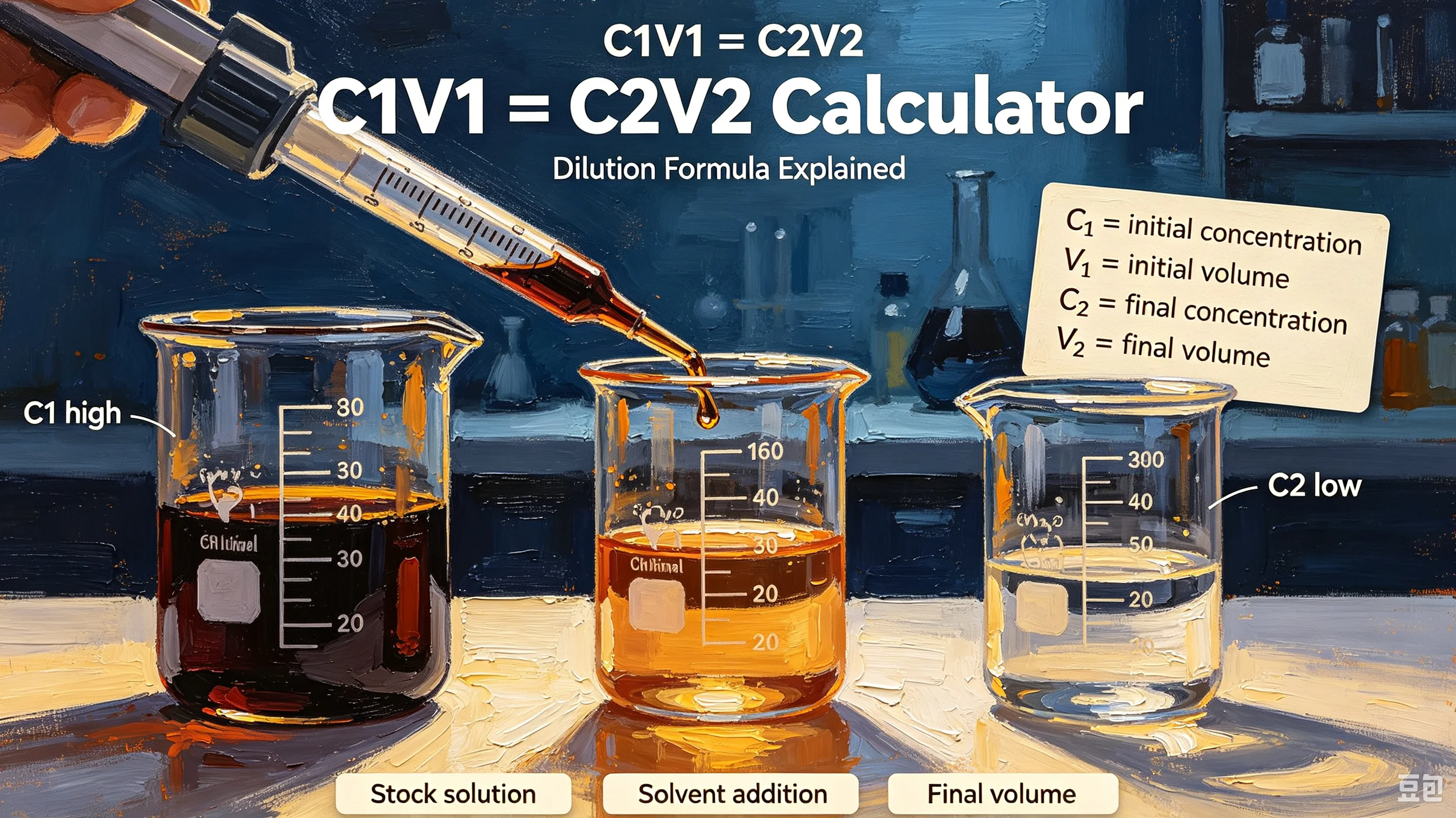
The C1V1 = C2V2 dilution formula lets you calculate how much stock solution to use. Learn the equation, step-by-step method, unit conversions, and worked examples for lab dilutions. Free calculator included.
Every lab worker faces this question: "I have a concentrated stock. How much do I add to make a working solution at the concentration I need?" The answer is the dilution formula C1V1 = C2V2 — the most useful equation in any biology or chemistry lab. It looks simple, but mistakes are common: mixing up units, forgetting that V2 is total volume, or calculating the wrong variable. This guide explains what each term means, walks through the step-by-step method, provides worked examples, and covers the pitfalls that ruin experiments.
The Formula: What Each Term Means
C₁V₁ = C₂V₂
Symbol | Meaning | Example |
|---|---|---|
C₁ | Initial concentration (stock) | 10 mM |
V₁ | Initial volume (amount of stock to use) | ? mL (what you solve for) |
C₂ | Final concentration (target) | 1 mM |
V₂ | Final volume (total volume wanted) | 50 mL |
The formula works because the amount of solute is conserved during dilution. Adding solvent doesn't create or destroy the dissolved substance — it just spreads it into a larger volume. So:
Amount of solute = Concentration × Volume Before dilution: C₁ × V₁ After dilution: C₂ × V₂ These are equal: C₁V₁ = C₂V₂
The golden rule: All concentration units must match (both C₁ and C₂ in mM, or both in mg/mL, etc.), and all volume units must match (both in mL, or both in μL). Mismatched units are the #1 cause of dilution errors.
Step-by-Step Method
Step 1: Identify what you know and what you need. Write down all four variables. Three will be known; one is unknown (usually V₁ — how much stock to pipette).
Step 2: Check units. Make sure C₁ and C₂ use the same concentration unit, and V₁ and V₂ use the same volume unit. Convert if needed (see conversion table below).
Step 3: Rearrange the formula to solve for the unknown.
Solving for V₁ (most common): V₁ = (C₂ × V₂) / C₁
Solving for C₁: C₁ = (C₂ × V₂) / V₁
Solving for C₂: C₂ = (C₁ × V₁) / V₂
Solving for V₂: V₂ = (C₁ × V₁) / C₂
Step 4: Plug in the numbers and calculate.
Step 5: Calculate the solvent to add. V₁ is the amount of stock to add. The amount of solvent (water, buffer, media) to add is:
Solvent volume = V₂ − V₁
This is the most commonly forgotten step. V₂ is the total final volume, not the amount of solvent.
Step 6: Verify. Sanity-check: if C₁ > C₂ (you're diluting), then V₁ < V₂ (you use less stock than final volume). If your answer says V₁ > V₂, you made a mistake.
Worked Examples
Example 1: Basic dilution (most common) You have a 10 mM stock solution. You need 50 mL of 1 mM working solution. How much stock do you use?
C₁ = 10 mM, V₁ = ?, C₂ = 1 mM, V₂ = 50 mL V₁ = (C₂ × V₂) / C₁ = (1 × 50) / 10 = 5 mL Solvent to add = 50 − 5 = 45 mL
Answer: Pipette 5 mL of 10 mM stock, add 45 mL of solvent. Total = 50 mL of 1 mM.
Example 2: Antibody dilution You have an antibody at 1 mg/mL. You need 10 mL of a 1:1000 dilution (1 μg/mL). How much antibody?
C₁ = 1 mg/mL = 1000 μg/mL, C₂ = 1 μg/mL, V₂ = 10 mL V₁ = (1 × 10) / 1000 = 0.01 mL = 10 μL Solvent = 10 − 0.01 = 9.99 mL
Answer: Add 10 μL antibody to 9.99 mL buffer.
Note: We converted C₁ from mg/mL to μg/mL so both concentrations use the same unit. This is critical.
Example 3: Solving for final concentration You add 200 μL of 5 M NaCl to 800 μL of water. What's the final concentration?
C₁ = 5 M, V₁ = 200 μL, C₂ = ?, V₂ = 200 + 800 = 1000 μL C₂ = (C₁ × V₁) / V₂ = (5 × 200) / 1000 = 1 M
Answer: Final concentration is 1 M NaCl. (This is a 1:5 dilution.)
Example 4: Making a larger volume from dilute stock You have 0.5 M EDTA. You need 200 mL of 10 mM EDTA. How much stock?
C₁ = 0.5 M = 500 mM, C₂ = 10 mM, V₂ = 200 mL V₁ = (10 × 200) / 500 = 4 mL Solvent = 200 − 4 = 196 mL
Answer: 4 mL of 0.5 M EDTA + 196 mL water = 200 mL of 10 mM EDTA.
Unit Conversion Quick Reference
Mismatched units cause the most errors. Here are the conversions you'll use most:
Concentration:
1 M = 1000 mM = 1,000,000 μM = 1,000,000,000 nM
1 mg/mL = 1000 μg/mL = 1,000,000 ng/mL
For molar ↔ mass: mg/mL = M × MW (molecular weight in g/mol)
Volume:
1 L = 1000 mL = 1,000,000 μL
1 mL = 1000 μL
Pro tip: When in doubt, convert everything to the smaller unit. If C₁ is in M and C₂ is in mM, convert C₁ to mM (multiply by 1000). This avoids decimal errors.
Dilution Factor
The dilution factor (DF) tells you how much you're diluting the stock:
DF = C₁ / C₂ = V₂ / V₁
A 1:10 dilution means DF = 10 (final volume is 10× the stock volume)
A 1:1000 dilution means DF = 1000
If you know the dilution factor, V₁ simplifies to:
V₁ = V₂ / DF
Example: 1:1000 dilution into 10 mL → V₁ = 10 / 1000 = 0.01 mL = 10 μL.
Serial Dilutions
When you need a very large dilution (e.g., 1:1,000,000), doing it in one step requires pipetting tiny volumes (1 μL into 1 L), which is inaccurate. Instead, do serial dilutions — multiple smaller dilution steps multiplied together.
Example: 1:1,000,000 in three steps of 1:100 each:
100 × 100 × 100 = 1,000,000
Step 1: 10 μL stock + 990 μL buffer = 1:100 Step 2: 10 μL of Step 1 + 990 μL buffer = 1:10,000 Step 3: 10 μL of Step 2 + 990 μL buffer = 1:1,000,000
Each step uses the C1V1 = C2V2 formula independently. Serial dilutions are more accurate because each step uses a reasonable pipette volume.
Common Mistakes
Forgetting that V₂ is total volume. V₂ is the final total volume (stock + solvent), not the amount of solvent. If you need 50 mL total and use 5 mL stock, you add 45 mL solvent — not 50 mL. Adding 50 mL solvent gives 55 mL total, which is wrong.
Mismatched units. C₁ in M and C₂ in mM? Convert first. V₁ in μL and V₂ in mL? Convert first. One decimal mistake = 10× or 1000× error in concentration.
Confusing C₁ and C₂. C₁ is always the starting (stock) concentration — it's higher. C₂ is the final (target) concentration — it's lower. If C₁ < C₂, you're not diluting — you're concentrating, which the formula can still calculate but requires removing solvent (evaporation), not adding it.
Pipetting too small a volume. If V₁ = 0.1 μL, you can't accurately pipette that. Do a serial dilution instead, or start with a less concentrated stock.
Ignoring the solvent composition. Diluting with water when you should dilute with buffer changes the final buffer concentration and pH. Always dilute with the appropriate solvent.
Not mixing thoroughly. After adding stock to solvent, mix well (vortex, invert, or pipette up and down). Incomplete mixing means the concentration isn't uniform.
When C1V1 = C2V2 Doesn't Apply
The formula assumes ideal dilution — no volume changes upon mixing, no chemical reactions, and no significant heat of dilution. For most aqueous lab solutions, this holds. Exceptions:
Mixing strong acids with water (volume contracts slightly; always add acid to water)
Solutions with very high solute concentrations (non-ideal behavior)
Cases where the solute reacts with the solvent
For routine lab work (buffers, antibodies, media, salts), C1V1 = C2V2 is accurate enough.
Start Calculating
Use the chembioTube C1V1 Calculator to solve any dilution in seconds. Enter any three of C₁, V₁, C₂, V₂ — get the fourth instantly, plus solvent volume and dilution factor. Supports M, mM, μM, mg/mL, μg/mL, L, mL, and μL. Free, no signup, runs in your browser.