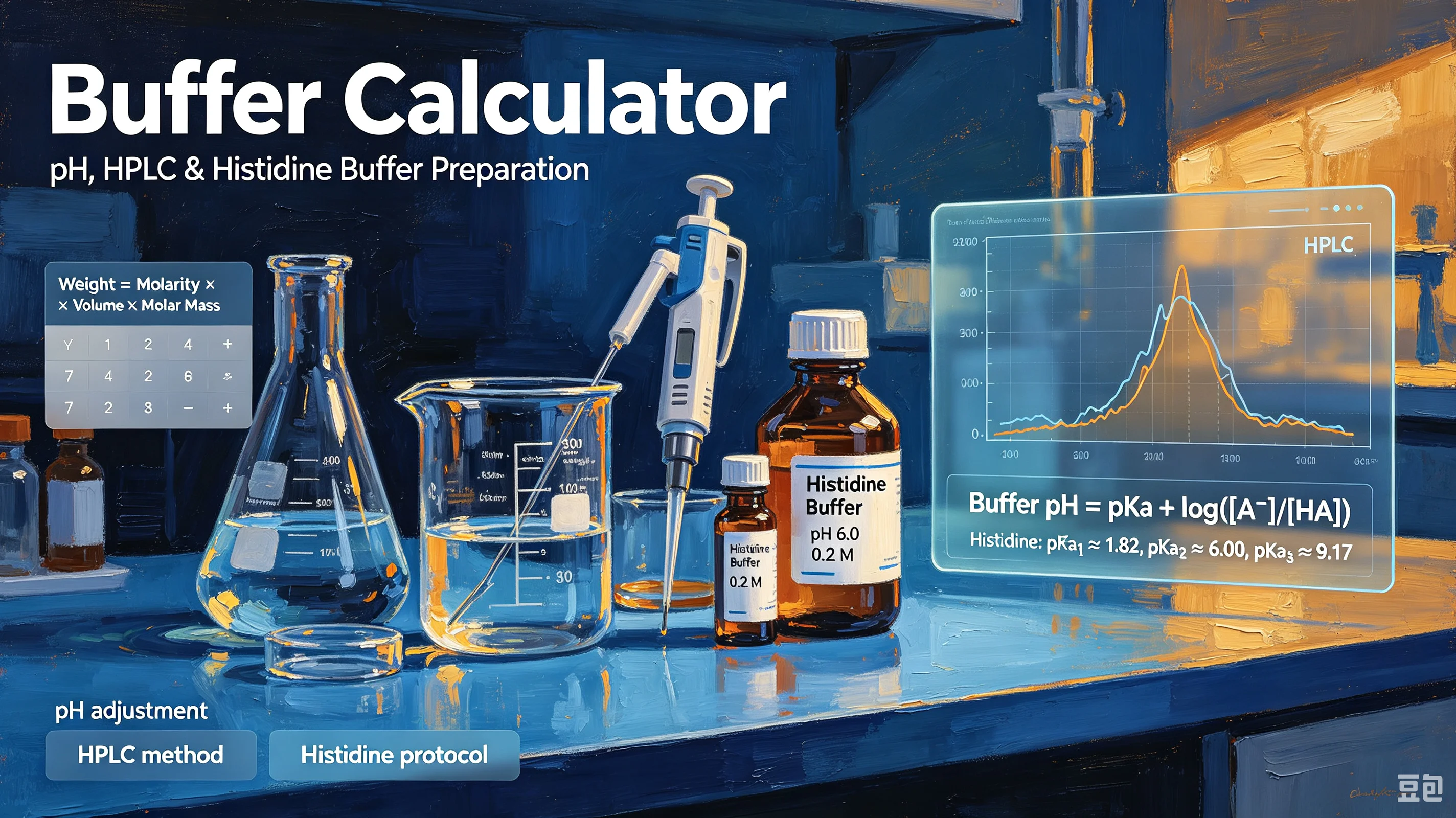
Calculate buffer pH and recipe with the Henderson-Hasselbalch equation. Covers Tris, PBS, histidine, and HPLC mobile phase buffers. Step-by-step preparation guide with common mistakes to avoid. Free calculator included.
A buffer keeps pH stable during a reaction — and getting the pH wrong can ruin an enzyme assay, a protein purification, or an HPLC separation. Yet many researchers still mix buffers by hand, guessing ratios and hoping for the best. A buffer calculator removes the guesswork: enter your target pH, pick a buffer system, and get the exact ratio of acid to conjugate base. This guide covers the math behind buffers, the most common buffer systems, a step-by-step preparation protocol, and special considerations for histidine and HPLC buffers.
The Math: Henderson-Hasselbalch Equation
Every buffer calculation starts with the Henderson-Hasselbalch equation:
pH = pKa + log([A⁻] / [HA])
Where:
pH = your target pH
pKa = the acid dissociation constant of the buffer (temperature-dependent)
[A⁻] = concentration of the conjugate base (deprotonated form)
[HA] = concentration of the weak acid (protonated form)
Rearranged to solve for the ratio:
[A⁻] / [HA] = 10^(pH − pKa)
Key rule: A buffer works best within pKa ± 1 pH unit. Outside this range, one form dominates and the buffer loses its capacity to resist pH change. If your target pH is 7.4, choose a buffer with pKa between 6.4 and 8.4 — phosphate (7.20) or HEPES (7.48) are ideal; acetate (4.76) is not.
Example: You need 1 L of 50 mM phosphate buffer at pH 7.4. Phosphate's relevant pKa is 7.20.
Ratio = 10^(7.4 − 7.20) = 10^0.20 = 1.58 [A⁻] / [HA] = 1.58, meaning 61.3% base and 38.7% acid. For 50 mM total: 30.7 mM Na₂HPO₄ + 19.3 mM NaH₂PO₄.
Common Buffer Systems at a Glance
Buffer | Useful pH Range | pKa (25°C) | Common Use |
|---|---|---|---|
Acetate | 3.8–5.8 | 4.76 | Acidic reactions, HPLC |
MES | 5.2–7.1 | 6.10 | Biological assays |
Phosphate (PBS) | 6.2–8.2 | 7.20 | Cell culture, physiological |
MOPS | 6.2–8.2 | 7.20 | RNA work, electrophoresis |
HEPES | 6.5–8.5 | 7.48 | Cell culture, low UV |
Tris | 7.1–9.1 | 8.06 | Protein work, electrophoresis |
Glycine | 8.6–10.6 | 9.60 | SDS-PAGE, protein |
Carbonate | 9.2–11.2 | 10.33 | Alkaline reactions |
Step-by-Step Buffer Preparation
Step 1: Choose the right buffer. Match the buffer's pKa to your target pH (within ±1). Consider compatibility: phosphate precipitates with divalent cations; Tris reacts with some enzymes and is temperature-sensitive; HEPES is more expensive but stable.
Step 2: Calculate the ratio. Use the Henderson-Hasselbalch equation or a buffer calculator to find the acid:base ratio.
Step 3: Weigh and dissolve. Weigh both buffer components (or one component plus acid/base for adjustment). Dissolve in ~80% of final volume of deionized water.
Step 4: Adjust pH. Use a calibrated pH meter. Add small amounts of concentrated acid (HCl) or base (NaOH) to fine-tune. Never adjust pH after bringing to final volume — adding acid/base changes the volume.
Step 5: Bring to final volume. Transfer to a volumetric flask and add water to the mark. Mix thoroughly.
Step 6: Verify and store. Re-check pH if precision matters. Label with composition, pH, date, and storage conditions. Most buffers are stable at 4°C for weeks; sterile-filter for cell culture use.
Histidine Buffer: Special Considerations
Histidine buffer (pKa ≈ 6.04 at 25°C) is uniquely useful because its imidazole side chain provides buffering in the mildly acidic range (pH 5.5–7.0) — a gap where few other biological buffers work well.
Why researchers use histidine buffer:
Protein purification: Histidine's imidazole group competes with His-tagged proteins for Ni-NTA binding sites, making it the standard elution buffer (typically 250 mM imidazole, pH 8.0).
HPLC / LC-MS: Histidine is volatile enough for some MS applications and provides good buffering near pH 6.
Enzyme assays: Many enzymes have optimal activity near pH 6, where phosphate is less effective and MES may interfere.
Preparation tip: Histidine buffer is often made by titrating L-histidine (free base) with HCl to target pH, rather than mixing histidine and histidine-HCl separately. A 50 mM histidine solution titrated to pH 6.0 requires roughly equimolar HCl.
Watch out: Histidine absorbs UV at 214 nm, so it can interfere with HPLC detection at low wavelengths. Use formic acid or acetic acid if UV detection below 220 nm is critical.
HPLC Mobile Phase Buffers
HPLC buffers have additional constraints beyond pH:
Volatility matters. For LC-MS, use volatile buffers: formic acid (pKa 3.75), acetic acid (4.76), ammonium acetate, or ammonium formate. Non-volatile buffers (phosphate, Tris) contaminate the MS source.
Buffer concentration. Typical HPLC buffer concentrations are 5–50 mM. Too low = poor pH control; too high = salt precipitation and pump seal damage.
pH and retention. In reversed-phase HPLC, pH controls ionization of analytes. For acidic analytes, use pH 2–3 (suppress ionization, increase retention). For basic analytes, use pH 7–8 or pH < pKa − 2.
UV transparency. Formic acid and acetic acid are UV-transparent above 210 nm. TFA (trifluoroacetic acid) is common for peptide separations but absorbs below 210 nm and ion-pairs with analytes.
Common HPLC buffer recipes:
0.1% formic acid in water (pH ~2.7) — universal LC-MS starting point
10 mM ammonium acetate, pH 5.0 — good for small molecules
20 mM phosphate, pH 7.0 — for UV detection where MS isn't needed
0.1% TFA in water/acetonitrile — peptide and protein separations
Common Mistakes
Ignoring temperature. Tris pKa drops 0.031 units per °C. A buffer made at pH 8.0 at 25°C becomes pH 8.3 at 4°C. Phosphate is much less temperature-sensitive (0.0028 units/°C). Always note the temperature at which you measured pH.
Adjusting pH after final volume. Adding HCl or NaOH changes the total volume, making your concentration wrong. Adjust at ~80% volume, then bring to final volume.
Using the wrong pKa. Polyprotic acids (phosphate, citrate) have multiple pKa values. Use the one nearest your target pH. For pH 7.4 phosphate buffer, use pKa2 = 7.20, not pKa1 = 2.15.
Forgetting ionic strength. Buffer concentration affects ionic strength, which affects enzyme activity, protein solubility, and HPLC retention. "50 mM phosphate" and "100 mM phosphate" at the same pH are not equivalent experiments.
Using expired or contaminated buffers. Microbes grow in phosphate and Tris buffers. Sterile-filter or add sodium azide (0.02%) for long-term storage — but never use azide in cell culture or HPLC (it damages columns and detectors).
Start Calculating
Use the chembioTube Buffer Calculator to compute pH, acid:base ratios, and full recipes for phosphate, Tris, histidine, acetate, HEPES, and HPLC mobile phase buffers. Enter target pH and concentration — get exact masses and volumes in one click. Free, no signup, runs in your browser.