Ionization energy increases across a period and decreases down a group — but with key exceptions. Learn why N > O and Be > B, what causes the giant jump between first and second ionization energy, and visualize all 118 elements on an interactive heatmap.
Ionization energy is the energy required to rip an electron away from an atom. It tells you how tightly an atom holds its electrons — and that single property predicts metallic character, reactivity, oxidation states, and even the type of bonds an atom forms. The broad trend is straightforward: ionization energy climbs toward the top-right of the periodic table. But the exceptions are where things get interesting, and they're the reason every chemistry exam tests this topic. This guide covers the trends, the physics behind them, the famous anomalies, and how an interactive heatmap makes it all visible at a glance.
What Is Ionization Energy?
The first ionization energy (IE₁) is the minimum energy needed to remove the outermost electron from a neutral gaseous atom:
X(g) → X⁺(g) + e⁻
Units are typically kJ/mol (energy per mole of atoms) or eV (energy per single atom). 1 eV ≈ 96.5 kJ/mol.
High ionization energy = the atom holds electrons tightly = hard to remove an electron = nonmetallic character (e.g., helium: 2,372 kJ/mol)
Low ionization energy = the atom gives up electrons easily = metallic character (e.g., cesium: 376 kJ/mol)
The second ionization energy (IE₂) removes a second electron from the now-positive ion: X⁺ → X²⁺ + e⁻. It's always higher than IE₁ because removing an electron from a positive ion is harder than from a neutral atom.
The Two Broad Trends
Trend 1: Ionization energy increases across a period (left to right).
Period 2: Li (520) → Be (900) → B (801) → C (1,087) → N (1,402) → O (1,314) → F (1,681) → Ne (2,081) kJ/mol
Across a period, protons are added to the nucleus while electrons go into the same shell. Effective nuclear charge (Zeff) increases, pulling electrons closer and tighter. More energy is needed to pry one loose.
Trend 2: Ionization energy decreases down a group.
Group 1: H (1,312) → Li (520) → Na (496) → K (419) → Rb (403) → Cs (376) → Fr (~380) kJ/mol
Down a group, each step adds a new electron shell farther from the nucleus. The outer electron is more distant and better shielded, so it's easier to remove. Ionization energy drops.
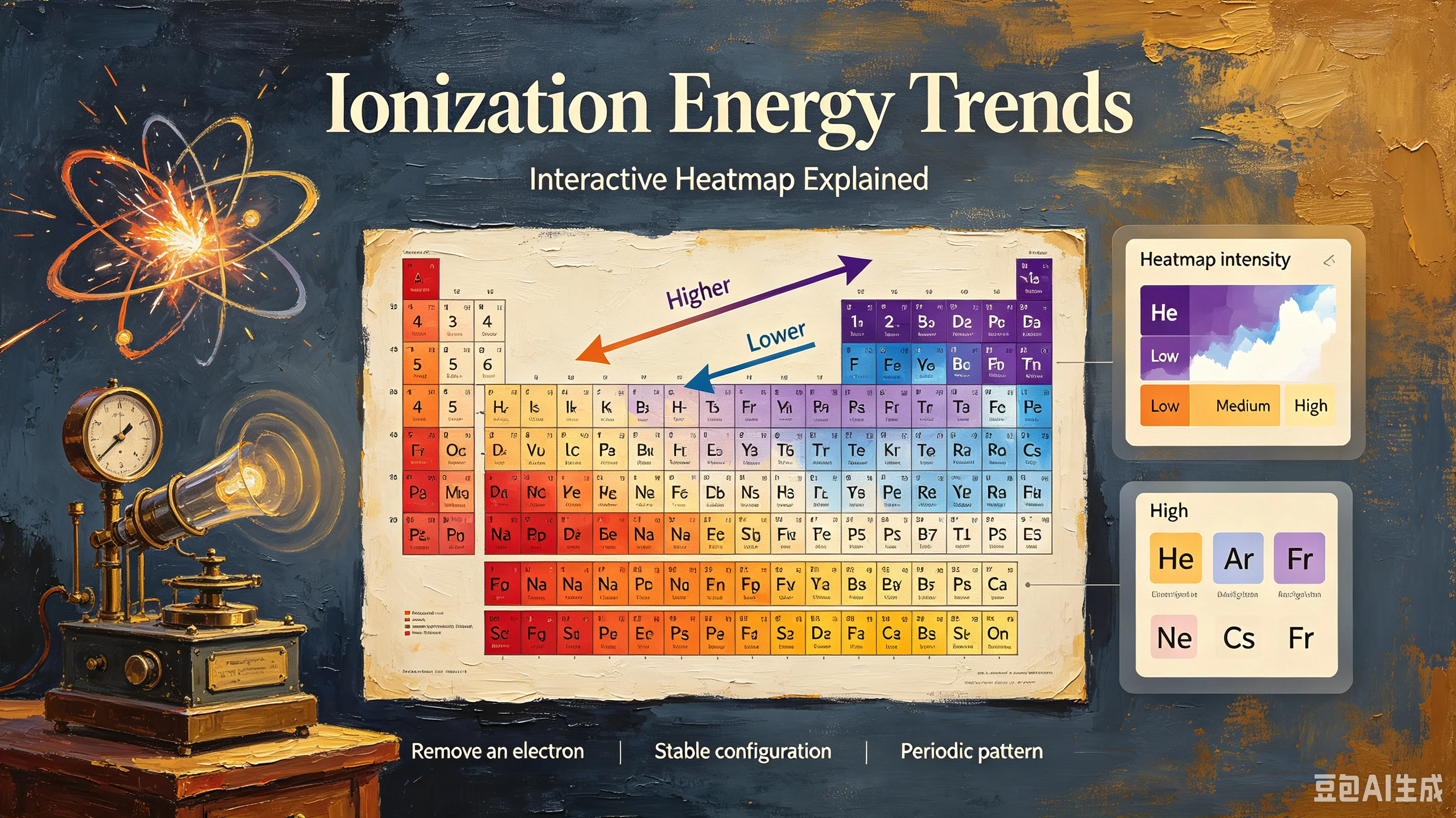
The combined result: helium (top-right) has the highest first ionization energy; francium/cesium (bottom-left) has the lowest. An ionization energy heatmap renders this as a diagonal gradient — warm red in the top-right, cool blue in the bottom-left.
The Famous Exceptions
The overall trend is "up and to the right," but there are consistent dips that every chemistry student must know. These exceptions come from electron configuration stability:
Exception 1: Group 2 > Group 13 (Be > B, Mg > Al)
Be: [He] 2s² — the 2s orbital is full, which is extra stable. Removing an electron breaks a filled subshell.
B: [He] 2s² 2p¹ — the single 2p electron is higher in energy and easier to remove than a 2s electron.
Result: Be (900 kJ/mol) > B (801 kJ/mol), even though B is to the right of Be.
Same pattern: Mg (738) > Al (578) in Period 3.
Exception 2: Group 15 > Group 16 (N > O, P > S)
N: [He] 2s² 2p³ — the 2p subshell is half-filled (one electron in each of three p orbitals), a stable configuration.
O: [He] 2s² 2p⁴ — the fourth 2p electron must pair up in an orbital already containing one electron. Electron-electron repulsion in that paired orbital makes the fourth electron easier to remove.
Result: N (1,402 kJ/mol) > O (1,314 kJ/mol).
Same pattern: P (1,012) > S (1,000) in Period 3 (a smaller dip, but real).
These exceptions are not random — they're direct evidence that subshell stability (filled and half-filled orbitals) matters. On a heatmap, these dips appear as cool-colored tiles interrupting an otherwise warm gradient, making them impossible to miss.
Why These Trends Happen: The Physics
Three factors determine ionization energy:
1. Nuclear charge (Z). More protons = stronger attraction = higher IE. This drives the left-to-right increase.
2. Atomic radius. Larger atoms = electrons farther from nucleus = weaker attraction = lower IE. This drives the top-to-bottom decrease.
3. Shielding (screening). Inner electrons block the nucleus's pull on outer electrons. More inner shells = more shielding = lower IE. This also drives the top-to-bottom decrease.
Across a period, nuclear charge increases but shielding stays roughly constant (same shell). Net effect: Zeff increases, IE increases.
Down a group, nuclear charge increases and shielding increases (new shell), but the distance and shielding effects dominate. Net effect: IE decreases.
Successive Ionization Energies: The Giant Jump
Removing each subsequent electron requires more energy — but sometimes the jump is enormous. This happens when you start removing inner-shell electrons instead of valence electrons.
Example: Sodium (electron config [Ne] 3s¹)
IE₁ (remove 3s¹): 496 kJ/mol — easy, it's the only outer electron
IE₂ (remove from 2p⁶): 4,562 kJ/mol — 9× harder! You're now digging into the stable neon core
Example: Magnesium ([Ne] 3s²)
IE₁: 738 kJ/mol
IE₂: 1,451 kJ/mol (removing second 3s electron)
IE₃: 7,733 kJ/mol — 5× harder! Now you're breaking into the neon core
This pattern tells you an element's group number: the giant jump occurs after removing all valence electrons. For Group 1 (1 valence electron), the jump is between IE₁ and IE₂. For Group 2 (2 valence electrons), it's between IE₂ and IE₃. This is a classic exam question — and it explains why sodium always forms Na⁺, never Na²⁺: the energy cost is prohibitive.
Ionization Energy and Chemical Behavior
Ionization energy directly predicts how an element behaves:
Low IE (metals, bottom-left): Electrons come off easily → form positive ions (cations), conduct electricity, react vigorously with water and oxygen. Cesium (376 kJ/mol) explodes on contact with water.
High IE (nonmetals, top-right): Electrons are held tightly → don't form positive ions, instead gain electrons to form anions or share electrons in covalent bonds. Helium (2,372 kJ/mol) never forms ions under normal conditions.
Intermediate IE (metalloids): Can lose or gain electrons depending on the reaction — the basis of semiconductor chemistry.
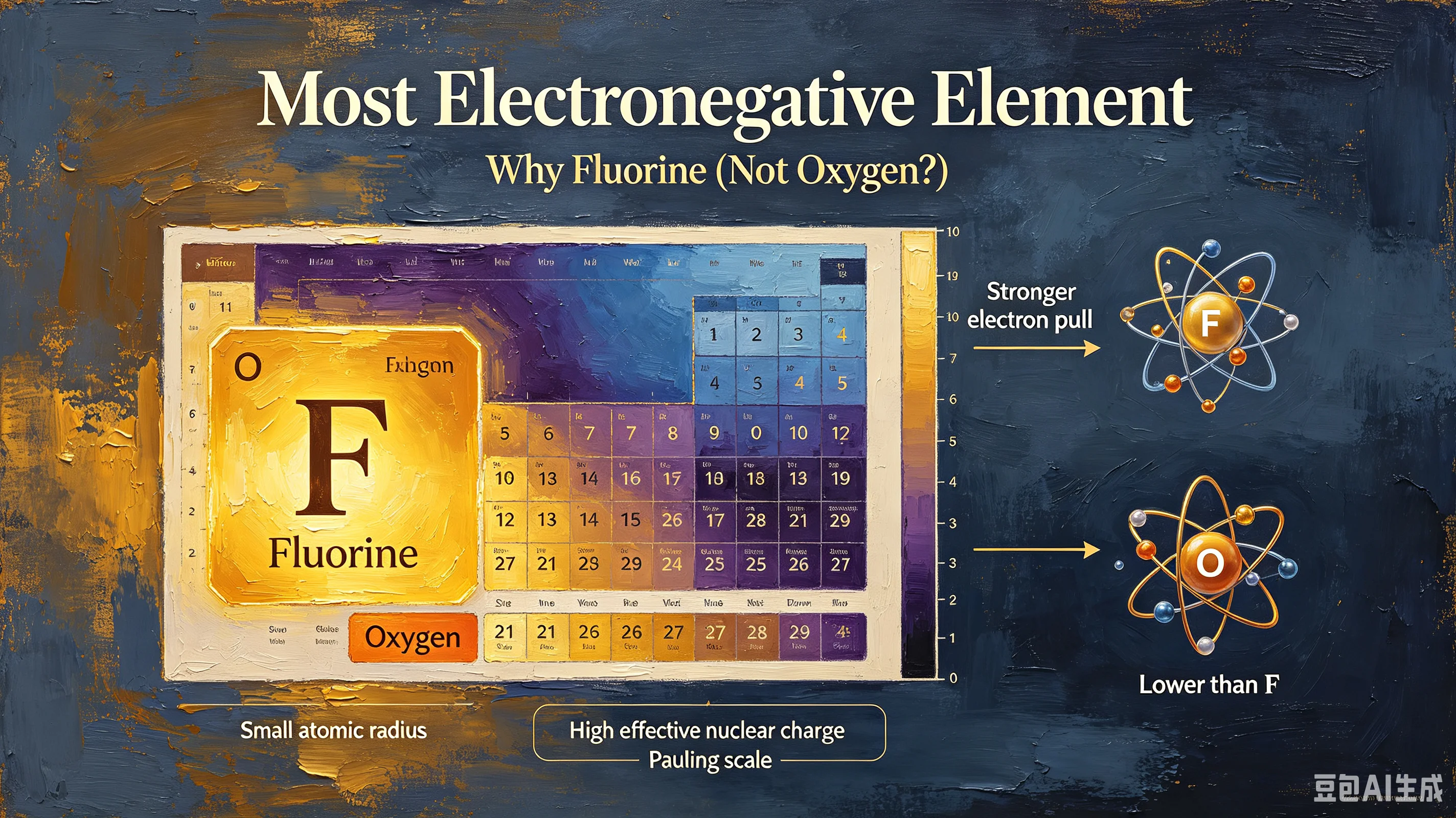
Ionization energy also correlates with electronegativity (both increase top-right) and is the inverse of atomic radius (smaller atoms = higher IE). Comparing these three heatmaps side by side reveals the unified physics behind all periodic trends.
Common Questions
Which element has the highest first ionization energy?
Helium (2,372 kJ/mol). Its 1s² configuration is a filled shell with maximum Zeff for a 1s electron. Helium never loses an electron in ordinary chemistry.
Which element has the lowest first ionization energy?
Cesium (376 kJ/mol) is the lowest measured. Francium is predicted to be slightly lower (~380 kJ/mol, actually slightly higher than Cs due to relativistic effects), but it's too radioactive for precise measurement.
Why does nitrogen have higher ionization energy than oxygen?
Nitrogen has a half-filled 2p³ configuration (one electron in each p orbital, all spin-parallel), which is unusually stable. Oxygen's 2p⁴ configuration forces one electron to pair up, creating repulsion that makes that electron easier to remove.
Is ionization energy the same as electronegativity?
No. Ionization energy is a measured energy (kJ/mol) for removing an electron. Electronegativity is a calculated scale (Pauling, 0.7–4.0) describing attraction in a bond. They correlate strongly but are different quantities.
Why do noble gases have the highest ionization energy?
They have full valence shells (ns²np⁶, except He which is 1s²). Removing an electron breaks a stable, complete shell — requiring maximum energy. This is also why noble gases are chemically inert.
Visualize With an Interactive Heatmap
An ionization energy heatmap colors each element by its IE₁ value. The top-right (He, Ne, F) glows warm red; the bottom-left (Cs, Fr, Rb) fades to cool blue. You can:
See the overall diagonal trend instantly
Spot the Be > B and N > O dips as cool interruptions in an otherwise warming gradient
Click any element for IE₁, IE₂, IE₃ values and electron configuration
Switch between first, second, and third ionization energy views to watch the giant jumps
Compare with atomic radius and electronegativity heatmaps to see the inverse relationships
The visual pattern is far more memorable than a table of numbers — your brain remembers where the red dips occur, not just what the values were.
Start Exploring
Open the chembioTube Interactive Periodic Table and switch to the ionization energy heatmap. Watch the top-right glow red, spot the N > O and Be > B anomalies, and click any element for successive ionization energy values. Free, no signup, runs in your browser.