Atomic radius increases down a group and decreases across a period. Learn why effective nuclear charge and electron shells drive this trend, plus key exceptions like gallium and the lanthanide contraction. Interactive heatmap included.
If you remember only one periodic trend, make it atomic radius. It explains why sodium is more reactive than lithium, why iodine is a solid while fluorine is a gas, and why transition metals have similar densities. The rule is simple: atoms get bigger as you go down and to the left of the periodic table. But the why behind it is what makes chemistry click. This guide breaks down the two trends, the physics of effective nuclear charge, the important exceptions, and how to see it all with a heatmap.
What Is Atomic Radius?
Atomic radius is the distance from an atom's nucleus to its outermost electron. Because electrons don't have a fixed position, radius is measured indirectly:
Covalent radius — half the distance between two bonded atoms (e.g., Cl–Cl bond = 199 pm, so Cl radius = 99 pm)
Metallic radius — half the distance between adjacent atoms in a metal lattice
Van der Waals radius — half the distance between two non-bonded atoms at closest approach
Different methods give slightly different numbers, but the trend is consistent across all of them. The smallest atom is helium (~31 pm van der Waals, or ~28 pm covalent estimate); the largest is francium or cesium (~260–270 pm). That's nearly a 10× difference in size.
The Two Rules
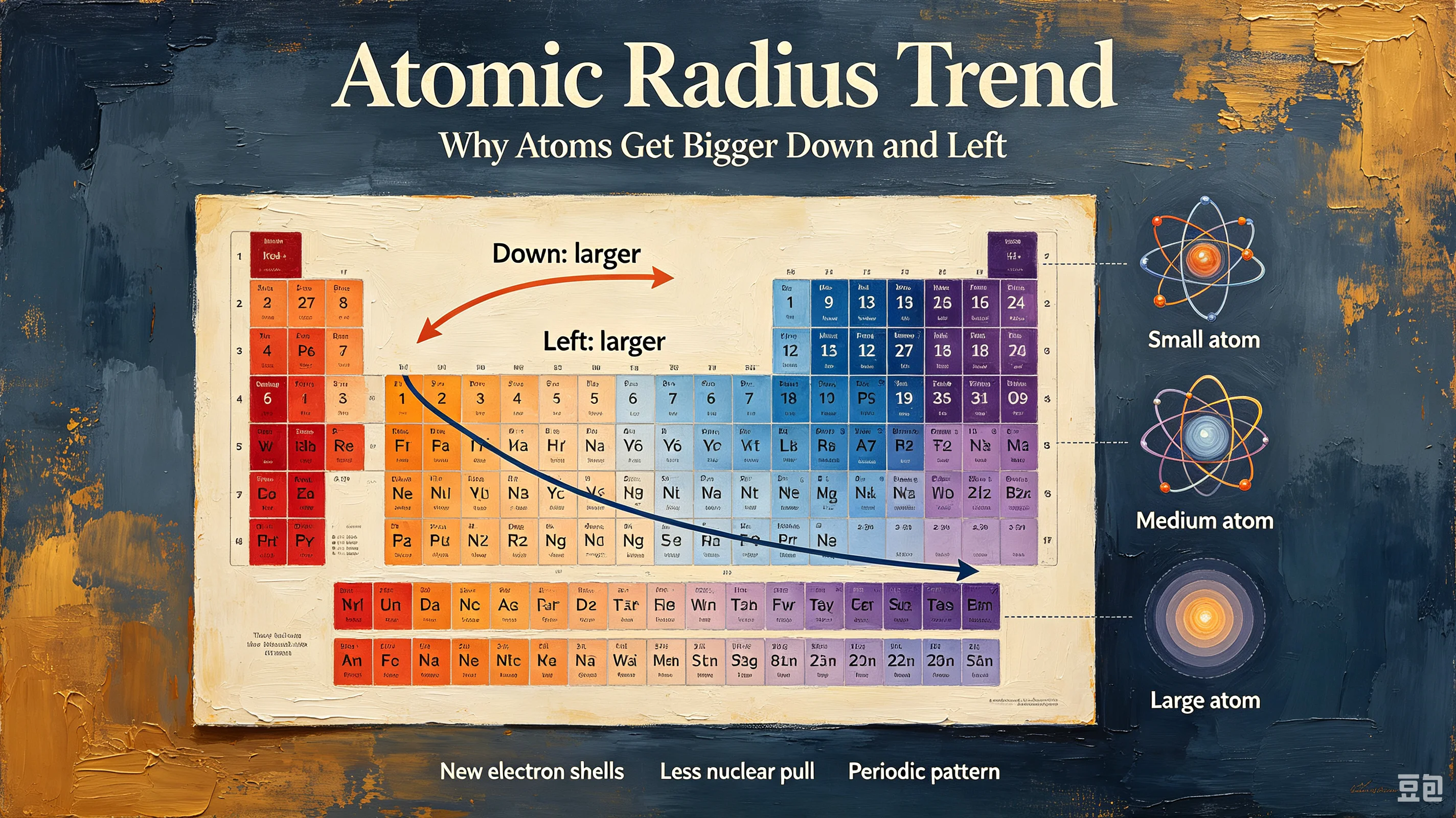
Rule 1: Atomic radius increases down a group. Li (152 pm) → Na (186 pm) → K (227 pm) → Rb (248 pm) → Cs (265 pm) → Fr (~270 pm)
Each step down adds a whole new electron shell. The outermost electrons sit farther from the nucleus, and inner shells shield them from the nucleus's pull. More shells = bigger atom.
Rule 2: Atomic radius decreases across a period (left to right). Na (186 pm) → Mg (160 pm) → Al (143 pm) → Si (117 pm) → P (110 pm) → S (104 pm) → Cl (99 pm) → Ar (~98 pm)
Across a period, electrons are added to the same shell while protons are added to the nucleus. More protons = stronger positive charge pulling electrons inward. The radius shrinks.
The result: the largest atoms cluster at the bottom-left (francium, cesium), and the smallest at the top-right (helium, fluorine). An atomic radius heatmap makes this diagonal gradient visible in one glance — deep red in the bottom-left fading to blue in the top-right.
The Physics: Effective Nuclear Charge
The key concept is effective nuclear charge (Zeff): the net positive charge experienced by an outer electron, after accounting for shielding by inner electrons.
Zeff = Z − S
Where Z = total protons, S = shielding constant (number of inner electrons, roughly).
Across a period: Z increases by 1 each step, but S stays roughly the same (electrons added to the same shell don't shield each other well). So Zeff increases steadily, pulling electrons closer. Radius decreases.
Down a group: Z increases, but S increases faster because each step adds a full inner shell. The new outer electron is shielded more effectively and sits in a larger orbital. Zeff doesn't increase enough to compensate for the extra distance. Radius increases.
Example — comparing Na and Cl:
Na: Z = 11, electron config [Ne] 3s¹. The 3s electron is shielded by 10 inner electrons. Zeff ≈ 11 − 10 = +1.
Cl: Z = 17, electron config [Ne] 3s² 3p⁵. Outer electrons are still shielded by ~10 inner electrons (same-shell electrons shield poorly). Zeff ≈ 17 − 10 = +7.
Chlorine's outer electrons feel a +7 pull vs. sodium's +1. That's why Cl (99 pm) is much smaller than Na (186 pm) despite being in the same period.
Important Exceptions
The trend is smooth for main-group elements, but there are notable dips:
Gallium is smaller than aluminum. Al (143 pm) → Ga (135 pm). Going down Group 13, you'd expect gallium to be bigger. But between Al and Ga, the first row of transition metals (Sc–Zn) sits in the periodic table. The 3d electrons added across the transition series are poor shielders, so the effective nuclear charge keeps increasing. By the time you reach gallium, the nucleus has 18 more protons than aluminum, but the radius has barely increased — in fact it shrinks. This is called the d-block contraction (or scandide contraction).
Thallium is smaller than expected. Tl (170 pm) vs. In (167 pm) — they're nearly the same size, despite Tl being one period below In. This is the lanthanide contraction: the 14 lanthanide elements (La–Lu) add 4f electrons that shield very poorly, steadily increasing Zeff. By the time you reach thallium, the accumulated contraction cancels the expected size increase.
Transition metals have nearly constant radius. Across the transition series (Sc to Zn), atomic radius barely changes (161 pm → 134 pm, much less dramatic than the main group). The added d-electrons shield the outer s-electrons effectively, so Zeff increases slowly. This is why transition metals have similar densities, melting points, and chemical behavior.
Hydrogen and helium are tricky. Hydrogen's covalent radius (~53 pm) is larger than helium's (~31 pm) because H has only one proton pulling one electron, while He has two protons pulling two electrons in the same 1s shell. Helium wins on Zeff.
Atomic Radius vs. Ionic Radius
When atoms gain or lose electrons, their size changes dramatically:
Cations (positive ions) are smaller than the parent atom. Losing an electron removes an entire shell (for metals) and increases Zeff per electron. Example: Na atom = 186 pm, Na⁺ = 102 pm — a 45% shrink.
Anions (negative ions) are larger than the parent atom. Gaining electrons increases electron-electron repulsion without adding nuclear charge. Example: Cl atom = 99 pm, Cl⁻ = 181 pm — an 83% expansion.
This is why ionic compounds like NaCl form a compact lattice: small Na⁺ cations and large Cl⁻ anions pack together efficiently.
Why This Trend Matters
Reactivity: Large atoms (bottom-left) hold outer electrons loosely → highly reactive metals (Cs explodes in water). Small atoms with high Zeff (top-right nonmetals) pull electrons strongly → reactive nonmetals (F₂ reacts with almost everything).
Bond length: Larger atoms form longer, weaker bonds. C–C bond = 154 pm; Si–Si bond = 234 pm and much weaker.
Density: Similar radii across transition metals + increasing atomic mass = density peaks at osmium and iridium (22.6 g/cm³).
Ionization energy: The inverse of atomic radius — smaller atoms hold electrons tighter, so ionization energy increases up and right.
Visualize With a Heatmap
An atomic radius heatmap colors each element by its radius value. The bottom-left glows warm red (large atoms), the top-right fades to cool blue (small atoms). You can:
See the diagonal gradient instantly
Spot the d-block and lanthanide contractions as flat patches
Click any element for its exact radius (covalent, metallic, and ionic)
Compare side-by-side with electronegativity or ionization energy heatmaps to see the inverse relationship
This visual approach beats memorizing a list of numbers — the spatial pattern sticks in memory.
Start Exploring
Open the chembioTube Interactive Periodic Table and switch to the atomic radius heatmap. Watch the bottom-left glow red and the top-right fade blue. Click any element for covalent, metallic, and ionic radius values. Free, no signup, runs in your browser.