This short guide gives you the exact formula, worked examples, and a free calculator to do the conversion instantly.
Converting molarity to mg/ml is one of the most common calculations in the lab. Whether you are preparing a buffer, diluting a drug, or making a protein solution, you need to know how many milligrams of solute are in each milliliter of solution.
This short guide gives you the exact formula, worked examples, and a free calculator to do the conversion instantly.
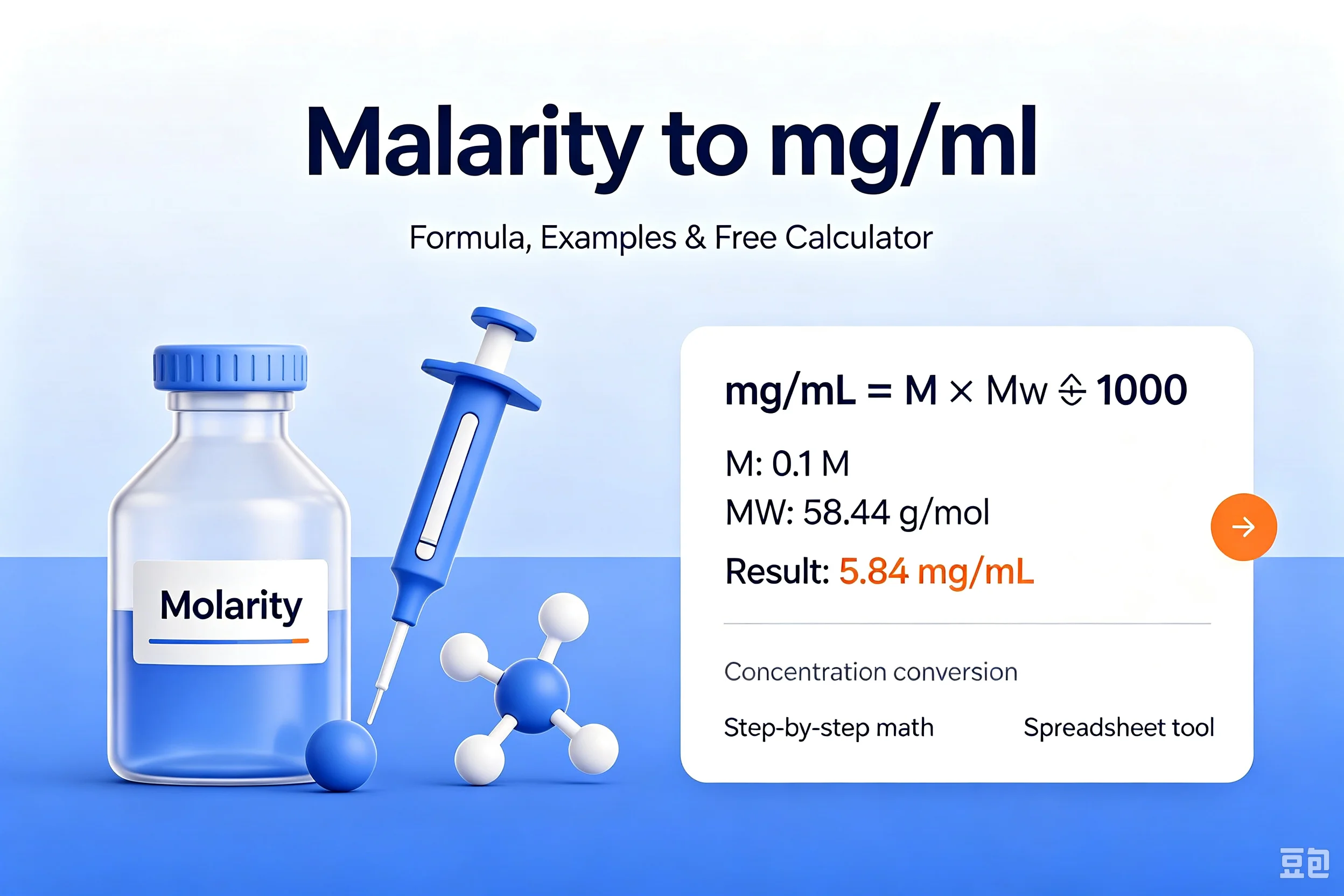
The relationship between molarity and mg/ml is simple:
mg/ml = Molarity (mol/L) × Molecular Weight (g/mol)
Because 1 mol/L equals 1 gram per liter for a compound with a molecular weight of 1 g/mol, multiplying molarity by molecular weight gives grams per liter. Since there are 1,000 milliliters in a liter, the result is already in mg/ml.
In other words:
1 M = 1 mol/L = MW g/L = MW mg/ml
So if you know the molarity and the molecular weight, you can get mg/ml in one step.
You want to prepare a 0.5 M NaCl solution. The molecular weight of NaCl is 58.44 g/mol.
mg/ml = 0.5 mol/L × 58.44 g/mol
mg/ml = 29.22 mg/ml
This means every milliliter of your solution contains 29.22 mg of NaCl.
You have a 10 mM glucose solution. Glucose has a molecular weight of 180.16 g/mol.
First, convert mM to M:
10 mM = 0.01 M
mg/ml = 0.01 mol/L × 180.16 g/mol
mg/ml = 1.8016 mg/ml
So 10 mM glucose equals approximately 1.8 mg/ml.
You need a 2 µM protein solution. The protein’s molecular weight is 50,000 g/mol.
Convert µM to M:
2 µM = 2 × 10⁻⁶ M
mg/ml = (2 × 10⁻⁶ mol/L) × 50,000 g/mol
mg/ml = 0.1 mg/ml
So 2 µM of this protein corresponds to 0.1 mg/ml.
The reverse calculation is just as easy:
Molarity (M) = mg/ml ÷ Molecular Weight (g/mol)
For example, if you have a solution at 5 mg/ml of a compound with MW = 200 g/mol:
Molarity = 5 mg/ml ÷ 200 g/mol
Molarity = 0.025 M = 25 mM
Confusing mM and M: Always convert millimolar or micromolar to molar before using the formula.
Using the wrong molecular weight: Use the molecular weight of the actual compound, including any salt or hydrate form.
Forgetting that mg/ml = g/L: The formula gives mg/ml directly; do not divide by 1,000 again.
Ignoring density: This conversion is for mass per volume based on molarity, not for weight/volume percentage. It assumes the solute does not change the final volume significantly.
Multiply the molarity (in mol/L) by the molecular weight (in g/mol). The result is the concentration in mg/ml.
Divide the mg/ml value by the molecular weight. The result is molarity in mol/L.
Molarity expresses concentration as moles per liter, while mg/ml expresses it as mass per volume. They are related through molecular weight.
No. You need the molecular weight because different compounds have different masses per mole.
Use the free Molarity to mg/ml Calculator on this site to convert any concentration instantly.
How to use it:
Enter the molarity (M, mM, or µM).
Enter the molecular weight.
Get the concentration in mg/ml immediately.
The tool also works in reverse — enter mg/ml and molecular weight to get molarity. Bookmark it for your next buffer preparation or dilution.