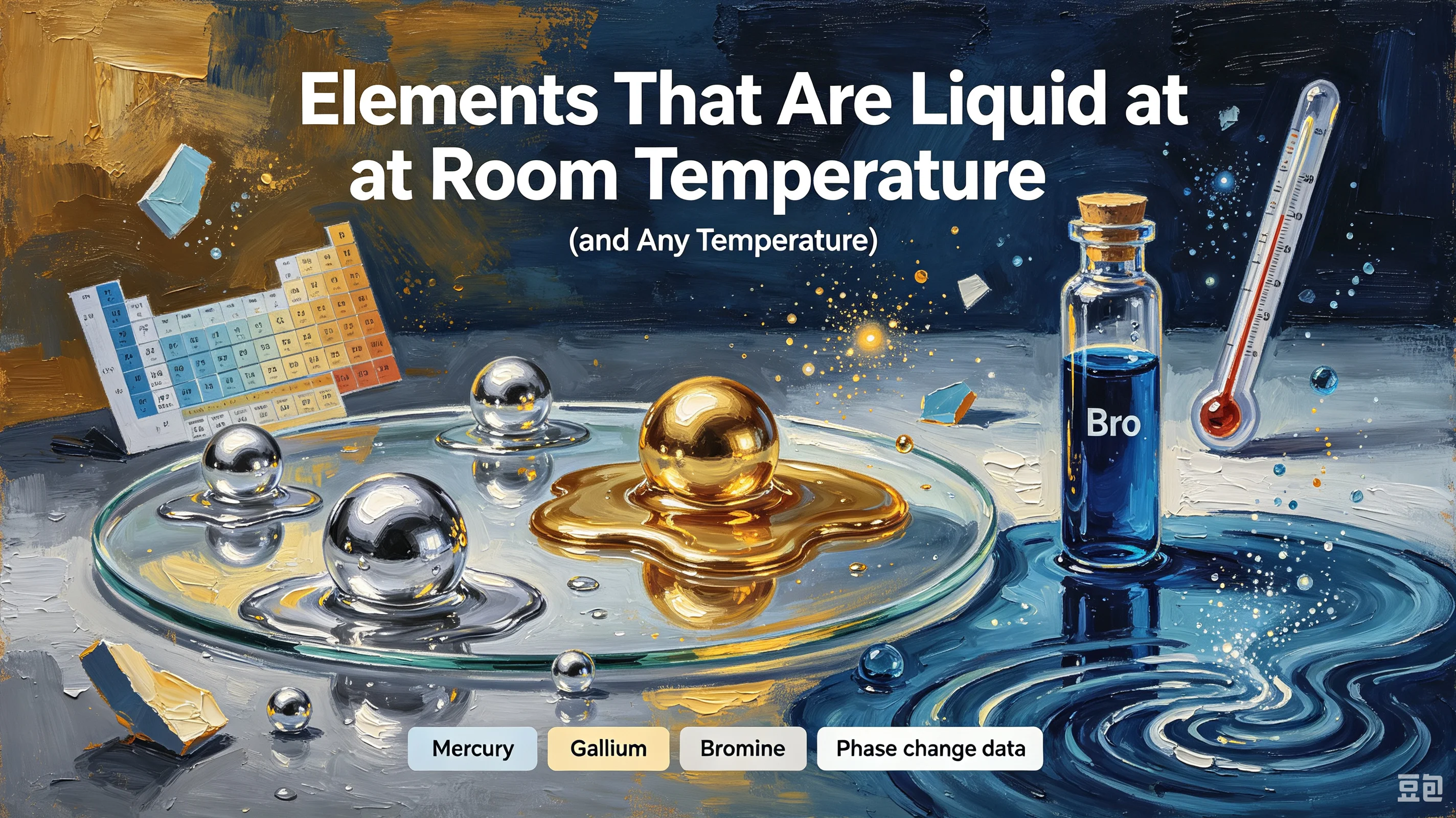
Only 2 elements are liquid at room temperature: mercury and bromine. But drag the temperature slider and discover which elements melt at body heat, 100°C, 500°C, and beyond. Interactive phase exploration for all 118 elements.
Out of 118 elements, only two are liquid at room temperature. That's a surprisingly small number — and it's one of the most commonly asked facts in chemistry. But "room temperature" is just one point on a wide spectrum. Warm things up by a few degrees, and two more elements melt. Warm to 100°C, and the list grows. This guide covers which elements are liquid at 25°C, which melt in your hand, and how to explore the phase of every element at any temperature using an interactive slider.
The Two Liquids at 25°C
At standard room temperature (25°C / 77°F), exactly two elements exist as liquids:
Mercury (Hg) — Melting point: -38.83°C Mercury is the only metal that's liquid at room temperature. Its unusual behavior comes from weak metallic bonding: mercury atoms hold onto their 6s electrons tightly (due to relativistic effects), so they don't share electrons easily with neighbors. This is why mercury forms beads, doesn't wet surfaces, and was historically used in thermometers.
Bromine (Br) — Melting point: -7.2°C Bromine is the only nonmetal that's liquid at room temperature. It's a reddish-brown, fuming liquid with a strong, irritating odor. Bromine is part of the halogen group, and its liquid state comes from having enough intermolecular (van der Waals) force to stay condensed at 25°C — unlike fluorine and chlorine, which are lighter and gaseous.
That's it. Just two. Every other element is either solid or gas at 25°C.
The "Melts in Your Hand" Elements
Four more elements have melting points just above room temperature. On a warm day, or held in a human hand (37°C), they become liquid:
表格
Element | Melting Point | Notes |
|---|---|---|
Francium (Fr) | ~27°C | Radioactive; melting point estimated, not precisely measured |
Cesium (Cs) | 28.44°C | Reactive alkali metal; melts from hand warmth |
Gallium (Ga) | 29.76°C | Famous for melting in your hand; safe to handle |
Rubidium (Rb) | 39.31°C | Reactive; melts on a very hot day or in a warm hand |
Gallium is the most famous example. It's a silvery metal that melts at 29.76°C — below body temperature. You can literally hold a solid piece of gallium and watch it turn into a silvery puddle in your palm. It's non-toxic (unlike mercury) and is often sold as a novelty for this exact trick.
Cesium melts at 28.44°C, but it's far too reactive to handle safely — it explodes on contact with water. If you could hold it (don't), it would melt almost instantly.
So at body temperature (37°C), the list of liquid elements grows from 2 to 5 (Hg, Br, Fr, Cs, Ga). At 40°C, rubidium joins, making it 6.
Explore Any Temperature With a Slider
A static list only tells you about 25°C. An interactive periodic table with a temperature slider lets you drag to any temperature and instantly see which elements are solid, liquid, or gas. Here's what you'll find at key milestones:
At 0°C (freezing): Still 2 liquids — mercury and bromine. Water is frozen, but these two aren't.
At 30°C (warm room): 5 liquids — add francium, cesium, and gallium. Gallium just crossed its melting point.
At 40°C (hot day): 6 liquids — rubidium melts at 39.3°C.
At 100°C (boiling water): Still roughly 6–8 liquids. Most metals remain solid. A few low-melting metals like indium (156.6°C) and tin (231.9°C) are getting close but haven't melted yet. Bromine boils at 59°C, so it's now a gas — dropping the count.
At 500°C: Many alkali and alkaline earth metals are now liquid: lithium (180°C), sodium (98°C), potassium (63°C), magnesium (650°C — still solid), calcium (842°C — still solid). Roughly 15–20 elements are liquid at this range.
At 1,000°C: Most common metals are molten: aluminum (660°C), copper (1,085°C — just melting), gold (1,064°C), silver (962°C), iron (1,538°C — still solid). About 40+ elements are liquid.
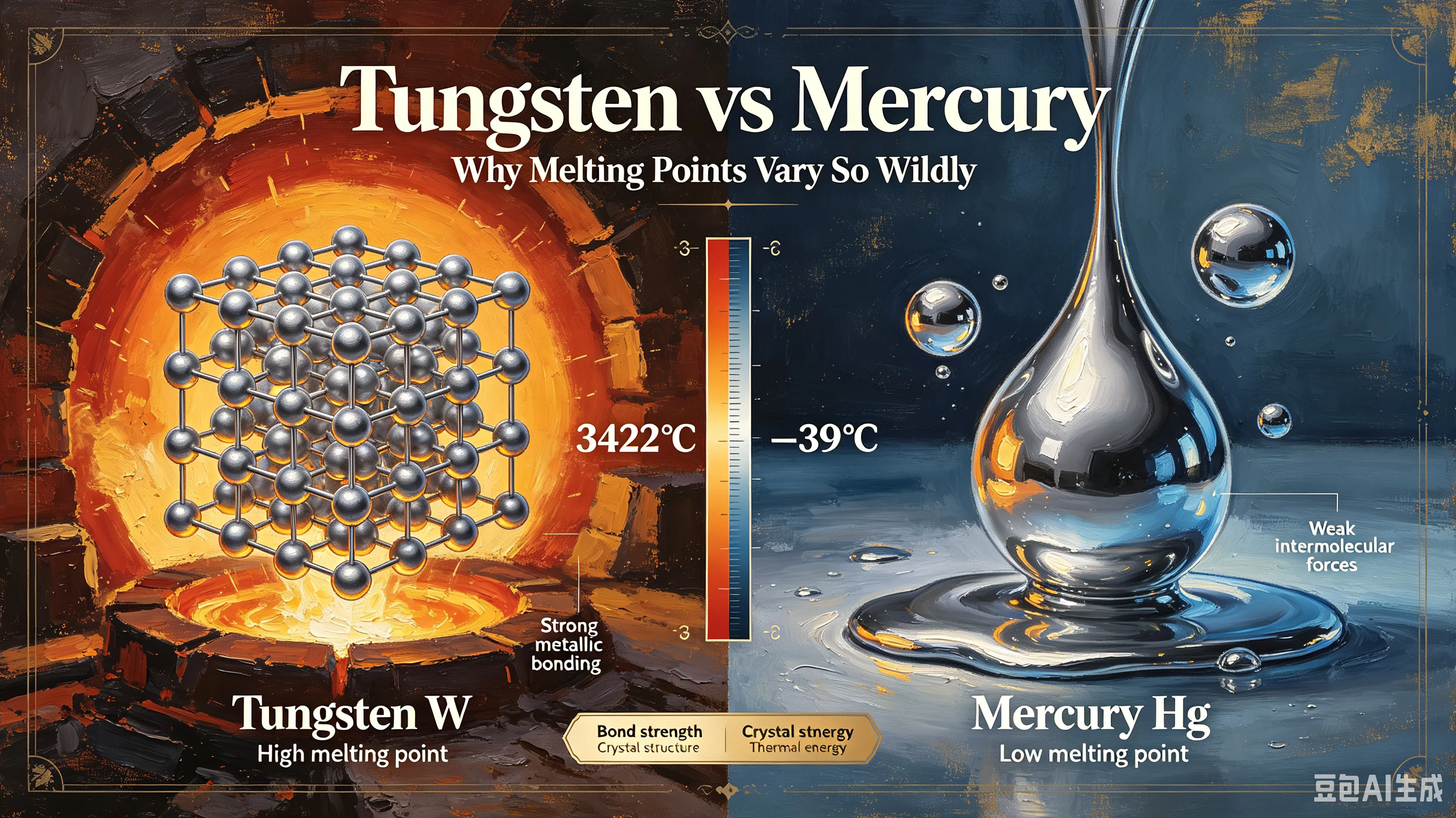
At 3,000°C: Even refractory metals melt: titanium (1,668°C), zirconium (1,855°C), chromium (1,907°C). Only a handful remain solid: tungsten (3,422°C), rhenium (3,186°C — just melted), osmium (3,033°C — just melted), tantalum (3,017°C — just melted), and carbon (sublimes at ~3,600°C).
At 3,500°C: Tungsten finally melts at 3,422°C. At this point, carbon is the only element still solid (it sublimes — turns directly to gas — around 3,600°C without a liquid phase at standard pressure).
Going the other direction:
At -100°C: Mercury freezes solid at -38.8°C, so it's gone. Bromine freezes at -7.2°C, also gone. Most gases have condensed into liquids: oxygen (-183°C boiling — still gas at -100°C), nitrogen (-196°C — still gas), but chlorine (-34°C boiling — now liquid) and ammonia-forming elements are condensed.
At -200°C: Almost everything is solid or liquid. Oxygen (-219°C melting — still liquid at -200°C) and nitrogen (-210°C melting — still liquid) are liquid. Only hydrogen (-259°C melting) and helium (-272°C at high pressure) remain gaseous.
At -269°C: Helium boils at -268.9°C. Below this, helium is the only element that remains liquid at standard pressure — it never freezes without pressure.
Why Do These Elements Have Such Low Melting Points?
The melting point of an element depends on the strength of the forces holding its atoms together:
Mercury has weak metallic bonding due to relativistic contraction of its 6s orbital. The electrons are held close to the nucleus and don't participate well in metallic bonding, so mercury atoms slide past each other easily.
Bromine forms diatomic Br₂ molecules held together by weak van der Waals forces. It's heavy enough (compared to F₂ and Cl₂) that these forces keep it liquid at room temperature, but not strong enough to make it solid.
Gallium, cesium, rubidium have unusual crystal structures or weak bonding that lower their melting points. Gallium's structure is more molecular than metallic in some ways.
Francium is predicted to have an even lower melting point than cesium, following the group trend, but it's so radioactive that no one has measured a visible sample.
Common Questions
How many elements are liquid at room temperature? Two: mercury (Hg) and bromine (Br). If you count elements that melt just above room temperature, add francium, cesium, gallium, and rubidium — making six total by 40°C.
Is gallium toxic? No, gallium is non-toxic and safe to handle. It's often used as a mercury substitute in medical thermometers. The "melts in your hand" trick is a popular science demonstration.
Why is mercury liquid when other metals are solid? Relativistic effects. Mercury's 6s electrons move at a significant fraction of the speed of light, causing them to contract toward the nucleus. This makes the electrons less available for metallic bonding, weakening the forces between mercury atoms and lowering the melting point.
Can an element have no liquid phase? Yes — at standard pressure, carbon sublimes (turns directly from solid to gas) at ~3,600°C without ever becoming liquid. Helium remains liquid down to absolute zero at standard pressure and only solidifies under 25+ atm of pressure.
What's the hottest an element can stay solid? Carbon has the highest sublimation point (~3,600°C), and tungsten has the highest melting point of any metal (3,422°C). Tungsten is the answer if you specifically mean "melts" rather than "sublimes."
Start Exploring
Open the chembioTube Interactive Periodic Table with the temperature slider. Drag to any temperature from -273°C to 6,000°C and watch elements change phase in real time. Click any element for its exact melting and boiling point. Free, no signup, runs in your browser.